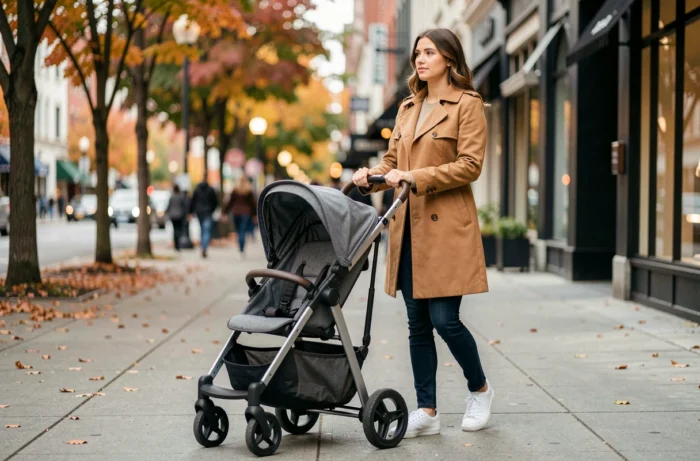
Getting off the subway with a baby in one arm, a diaper bag slung over the shoulder, and a stroller that refuses to fold on the stairs: we’ve all experienced this scene at least once. It’s precisely this type of daily constraint that drives more and more parents towards compact strollers. But between marketing promises and the reality of the sidewalk, the choice deserves careful consideration.
Anti-folding lock and EN 1888 standard: what the product sheet doesn’t always mention
When comparing compact strollers, we first look at the weight, then the folded volume. This reflex is logical, but it puts a technical criterion in the background: the anti-folding lock and compliance with the EN 1888 standard.
This European standard governs the stability of the chassis, the strength of the brakes, the five-point harness, and the locking mechanisms. A very lightweight model that doesn’t engage properly when opened poses a safety issue, not just a comfort one.
A concrete point to check upon receipt: unfold the stroller, engage the latch, then try to fold it without activating the folding mechanism. If the chassis moves or if the click isn’t solid, it may indicate a manufacturing defect. Recent recommendations suggest checking the Safety Gate platform for ongoing recalls on a specific model.
A guide dedicated to lightness and style on Petits Bambins clearly outlines this compromise between lightweight and chassis robustness, particularly for high-end urban models.
Compact stroller in airplane cabin: folded dimensions versus airline policy
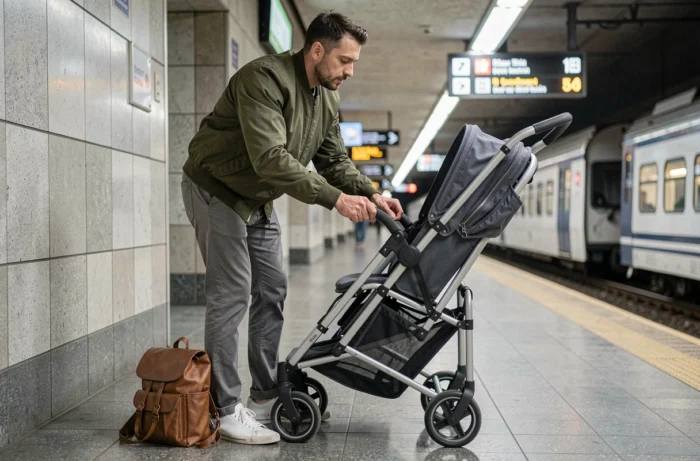
The mention of “cabin size” on the packaging of a compact stroller does not guarantee that it can be kept on board. We think we can resolve the issue by checking the folded dimensions, but the operational policy varies by airline, fare, and sometimes the aircraft.
On some flights, the stroller will be accepted up to the boarding gate, then placed in the hold. In the case of a connection, the rules may change between the two segments. The result: a stroller that perfectly meets the stated dimensions still ends up under the plane.
The only reliable approach is to contact the airline’s customer service directly before departure, specifying the exact model and its folded dimensions. It’s helpful to prepare a screenshot of the technical sheet.
Criteria to check before flying with a stroller
- The folded dimensions of the model, measured yourself (manufacturer data sometimes rounds in favor of the product)
- The cabin baggage policy of the airline for the specific flight booked, not the general policy on the website
- The presence of a hard or semi-rigid transport cover if the stroller must go in the hold, to protect the folding mechanism
One-handed folding and storage basket: two uses that often conflict
On paper, all compact strollers fold easily. In practice, you hold the baby with one arm and operate the mechanism with the other. One-handed folding then becomes a non-negotiable criterion for daily use in the city.
The problem is that models that offer the smoothest folding often sacrifice the basket capacity. A basket that can hold several kilos of groceries in addition to the diaper bag provides real comfort, but it adds weight to the chassis and complicates folding.
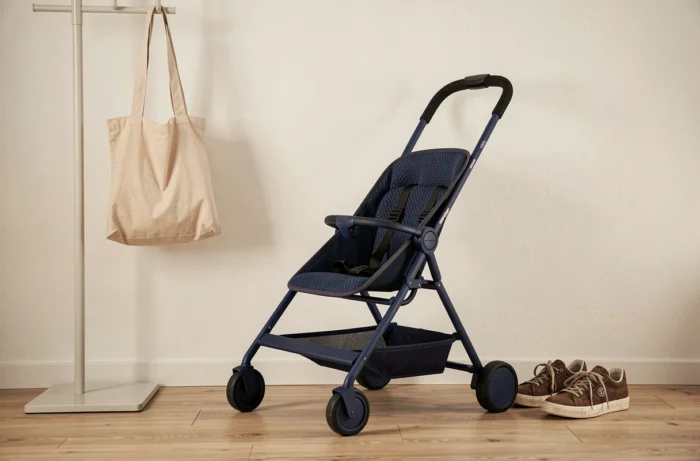
Feedback varies on this point depending on body types and habits. A parent who uses a baby carrier in addition will be satisfied with a minimal basket. Another who does grocery shopping on foot with the stroller will need a sturdy and accessible basket, even when the stroller is folded.
What distinguishes a good fold from a marketing fold
A fold that is truly usable on a daily basis meets three conditions: it can be activated with one hand without forcing, the stroller stands upright once folded (so it doesn’t have to be placed on the ground in the bus), and the mechanism doesn’t jam after a few months of use. This last point is rarely testable in-store.
Before buying, one can look for user feedback after six months or a year of use rather than tests conducted on a new model. Wear on the folding latch is a reliable indicator of the overall quality of the chassis.
Style and colors of compact strollers: a criterion that has become technical
The style of a stroller is no longer just an aesthetic bonus. Dark fabrics heat up more in summer, light canopies get dirty faster, and some water-repellent coatings make daily maintenance easier.
Several brands now offer editions with bio-sourced materials or recycled aluminum. The Bugaboo Butterfly 2, for example, shows a reduction in its carbon footprint compared to the previous model thanks to this type of material choice.
- A removable and machine-washable fabric avoids having to replace the cover after a year
- A structure made of recycled aluminum reduces weight without compromising the rigidity of the chassis
- A dark color with a UV index canopy better protects the child than a light model without treatment
The choice of color directly influences the durability and thermal comfort of the stroller, not just its appearance in photos.
When choosing a compact stroller, the usual criteria (weight, price, brand) are not enough. The locking mechanism, the actual policies of airlines, the durability of the folding mechanism over time, and the choice of textile materials weigh as much as the figures displayed on the product sheet. Testing in-store, reading long-term feedback, and checking EN 1888 compliance remain the safest methods before pulling out the credit card.