
Oxalic acid remains the go-to solution for treating tannin stains, water rings on wood, or rust marks on stone. Its effectiveness on these targeted issues is unquestionable. What poses a problem is its toxicological profile (skin irritant, dangerous if ingested) and its contribution to the domestic chemical load.
Some common uses of oxalic acid are based on a confusion between regular cleaning, de-graying, and biocide treatment, three functions that require different products.
Surface Compatibility: The Criterion That Acid Alternatives Do Not Address
Replacing oxalic acid with another acid (white vinegar, citric acid) does not solve anything if the substrate cannot tolerate a low pH. Vinegar and citric acid attack marble, limestone, certain waxed woods, and varnishes. On these materials, a neutral pH cleaner or diluted black soap remains the only truly safe option.
The problem also arises with composite decking materials. An acid, even a mild one, can cause irreversible discoloration on certain resins. Before choosing an alternative to oxalic acid, we recommend testing the product on a hidden area and checking the technical data sheet from the substrate manufacturer.
For those looking to replace oxalic acid with natural solutions, the first step is to precisely identify the type of stain and the material involved. Without this diagnosis, switching products is akin to groping in the dark.
Sodium Percarbonate for Brightening Wood: What It Does and What It Doesn’t
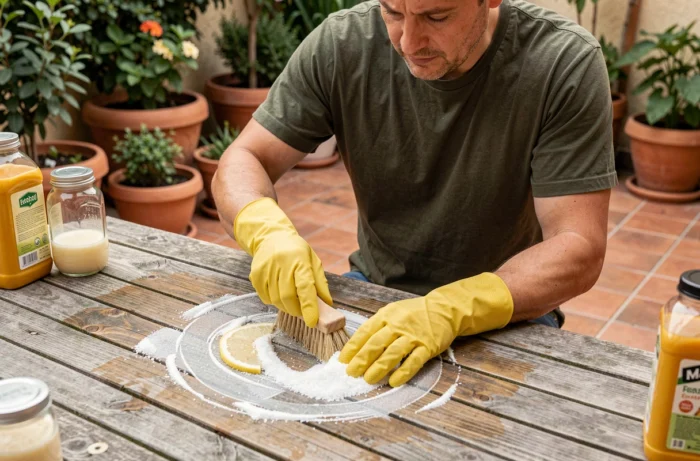
Sodium percarbonate is often presented as the universal substitute for oxalic acid. It yields good results on greening, superficial mold, and the gentle brightening of gray wood. It does not treat tannin rings or metallic oxidation stains, which are precisely the cases where oxalic acid excels.
Dissolved in hot water, percarbonate releases active oxygen. Its action is oxidative, not acidic. This difference in mechanism explains why it whitens fibers without dissolving mineral deposits. On exotic wood decking marked by iron streaks (screws, fittings), percarbonate alone will not suffice.
However, for general de-graying on pine, larch, or Douglas fir, it is a reliable ecological solution. The biodegradability of percarbonate is total: it decomposes into water, oxygen, and sodium carbonate. No toxic residues in runoff water.
Dosage and Application Conditions
Complete dissolution requires water at least 40 °C. Below this, the crystals remain partially active and the result is uneven. Apply the solution with a brush or low-pressure sprayer, let it act for about twenty minutes, then scrub in the direction of the fibers.
Thorough rinsing with clear water is mandatory, otherwise a whitish film will persist after drying. High-pressure cleaning from a short distance should be avoided: it raises the wood fibers and creates roughness that encourages re-graying.
Mechanical Cleaning of Outdoor Wood: The Zero Product Method
Before looking for a replacement product, the question deserves to be asked: do you really need a product? For regular maintenance of a terrace or garden furniture, regular sweeping, clear water, and black soap are sufficient in most cases.
The recommended protocol boils down to a thorough cleaning once or twice a year:
- Sweeping away plant debris and accumulated dust between the boards
- Washing with warm water mixed with liquid black soap (a few drops per liter)
- Scrubbing with a stiff-bristled brush in the direction of the boards, rinsing with clear water
- Natural drying before any potential application of protective oil
This protocol does not address established stains or deep graying. It prevents their appearance. Well-maintained and regularly oiled wood does not gray to the point of needing a chemical de-grayer.
Citric Acid and White Vinegar Against Rust: Effectiveness and Limits
For descaling and rust marks on compatible surfaces (tiles, stainless steel, enamel, stoneware), citric acid offers a chelating power comparable to that of oxalic acid. It binds iron ions in solution and allows their removal during rinsing.
White vinegar works on the same principle with a lower acid concentration. For light rust stains, it is often sufficient. For old or thick deposits, powdered citric acid dissolved in hot water will be more effective.
Where these two alternatives fail:
- Natural limestone (marble, travertine): dissolution of surface calcium carbonate
- Oiled or waxed wood: acid penetration that degrades the protective film
- Untreated cement joints: gradual attack on the binder
On these substrates, applying a damp baking soda paste, gently scrubbing, then rinsing, yields better results without the risk of chemical attack. Baking soda acts by gentle abrasion, not by acid reaction, making it compatible with nearly all domestic materials.
Linseed Oil and Preventive Protection: Reducing the Need for Curative Treatment
The best alternative to oxalic acid is to not need it at all. Regular application of a protective oil (linseed oil, tung oil) on outdoor wood significantly slows down graying and limits stain penetration.
Linseed oil, inexpensive and fully biodegradable, nourishes the fibers and creates a hydrophobic barrier. It does not form a surface film like a varnish, which prevents peeling. Its drying time is long, and it can become sticky if applied excessively.
A deck oiled twice a year generally does not require any de-grayer, whether chemical or natural. This preventive approach reduces the use of all treatment products, including oxalic acid, and extends the lifespan of the wood without generating residues in the environment.
The choice of an ecological alternative to oxalic acid depends on the diagnosis made on the stain and the substrate. Percarbonate for organic de-graying, citric acid for rust on hard surfaces, black soap and scrubbing for regular maintenance: each product has a specific scope. Mixing or interchanging them without considering the treated material can lead to damage that is sometimes more costly than the initial stain.