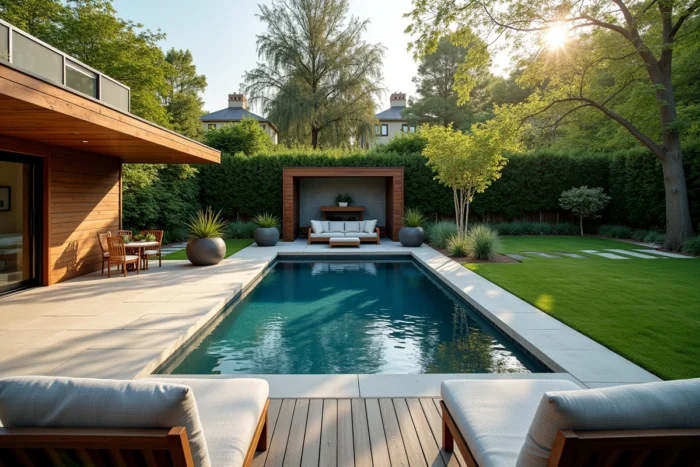
The cladding of an above-ground pool transforms a utilitarian basin into a true element of outdoor decor. With the market moving towards more compact and stylish models, closer to the aesthetics of in-ground pools, the choice of covering and peripheral layout becomes as much a technical as an aesthetic criterion. This ranking brings together ten concrete solutions, compared according to their durability, relative cost, and ability to integrate into a well-kept garden.
| Cladding Solution | Durability | Maintenance | Relative Cost |
|---|---|---|---|
| Exotic wood cladding (bangkirai) | Very high | Annual oiling | High |
| Composite boards (WPC) | Very high | Almost none | High |
| Siberian larch | High | Regular impregnation | Medium-high |
| Woven resin panels | High | Simple washing | Medium |
| Raised perimeter deck | Variable (depending on material) | Variable | High |
| Natural reed (willow, reed) | Low to medium | Frequent replacement | Low |
| Decorative gabions | Very high | None | Medium |
| Masonry planters | Very high | Plant maintenance | Medium-high |
| Shade sail + wooden screen | Medium | Low | Low-medium |
| Compact pool house | Very high | Variable | High |
1. Exotic wood cladding type bangkirai
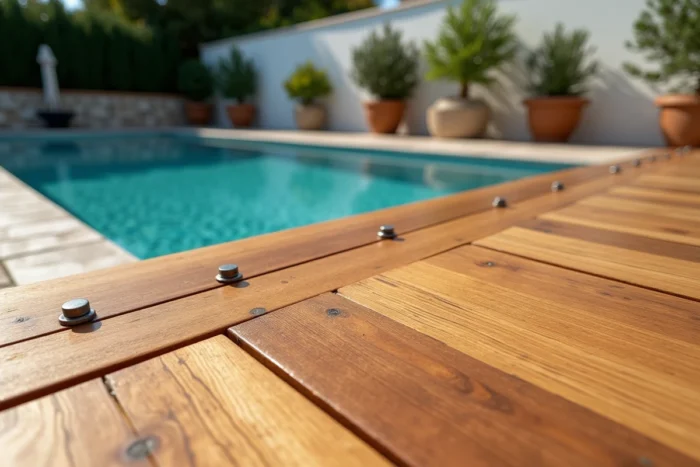
Bangkirai and massaranduba are among the most water-resistant and climate-resistant woods. An elegant cladding for above-ground pools in exotic wood provides a pleasant surface for bare feet and a warm hue that evolves into a silver-gray without treatment.
Annual oiling helps maintain the original color. This type of cladding adapts to both tubular pools and self-supporting models, provided an independent frame is planned that does not rest directly on the pool structure.
2. WPC composite boards
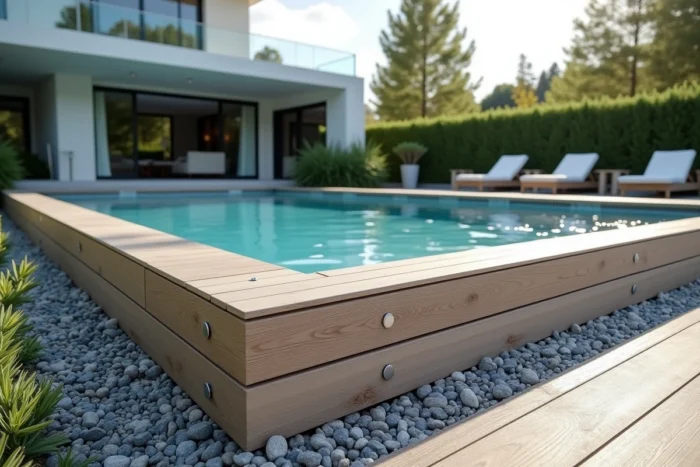
WPC (Wood Plastic Composite) combines wood flour and polymer. The result: no impregnation or sanding required, making it the least demanding solution in the long term.
The composite boards replicate the appearance of wood without its biological limitations (mold, splinters). However, the feel remains slightly different, and the surface may heat up more under direct sunlight. For a pool exposed to full sun, choosing a light color reduces this drawback.
3. Siberian larch in slatted design
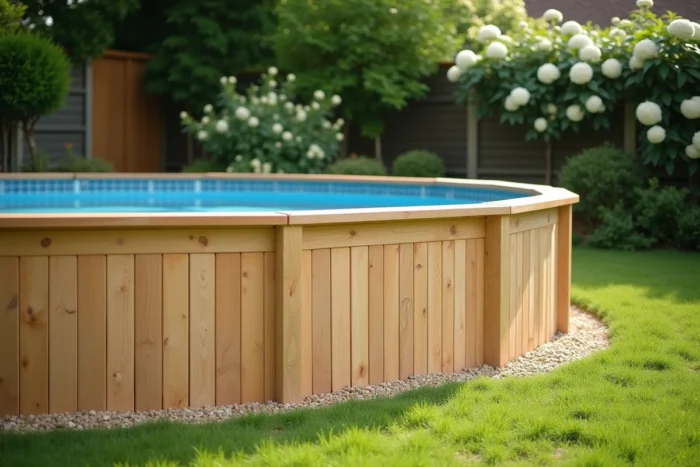
Siberian larch offers natural resistance to moisture superior to most European softwoods. Laid in a slatted design, it allows air to circulate behind the boards, which limits moisture accumulation against the pool wall.
This ventilation protects both the wood and the pool liner. The visual effect, more contemporary than solid cladding, lightens the visual mass of a large tubular pool.
4. Woven resin panels
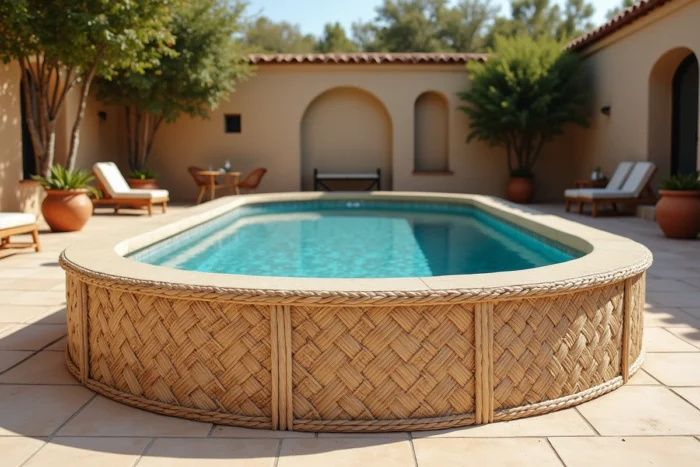
Woven resin, common in garden furniture, is available in rigid panels suitable for curved or rectangular contours. A simple jet wash is sufficient for seasonal maintenance.
This solution is aimed at inflatable or self-supporting pools of modest size. On a large pool, the panels may lack structural rigidity: fixing them to a treated class 4 frame solves this issue.
5. Raised perimeter deck
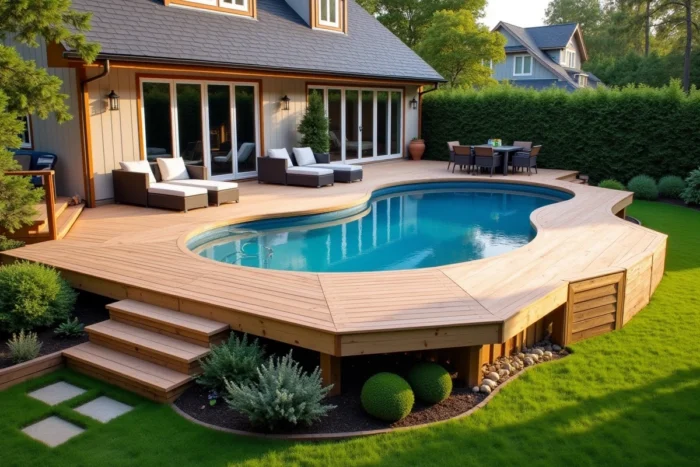
Building a deck level with the coping visually transforms an above-ground pool into a semi-inground basin. This is the solution that most closely resembles the aesthetics of an excavated pool.
The perimeter deck also facilitates access to the basin, eliminating the need for an external ladder. One point of caution: the flat rate value of pools for the development tax is set at €251 per m² of pool in 2026. A permanent cladding like a deck may change the declarative nature of the installation if the structure becomes fixed.
6. Natural reed (willow or reed)
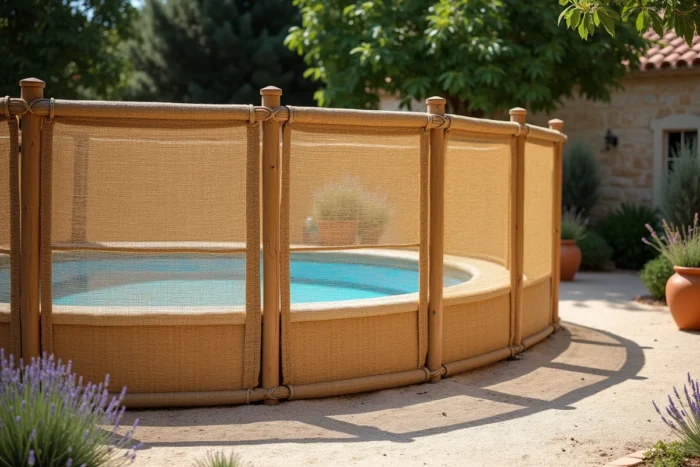
Reed rolls remain the most accessible solution. Bamboo, willow, or reed can be attached directly to the structure with wire or ties. The result is immediate, and the cost is minimal.
The trade-off is longevity: two to three seasons at best before the material degrades. For a tubular pool that is dismantled every autumn, this lifespan corresponds to the usage cycle. For a permanent pool, it is better to opt for treated wood.
7. Decorative gabions filled with pebbles
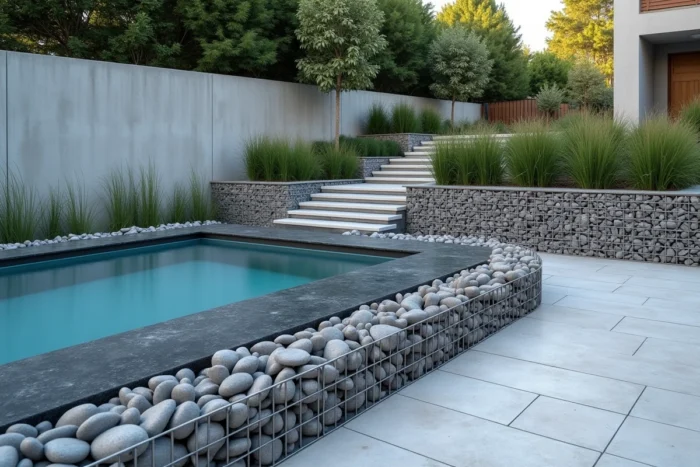
Wire cages filled with stones or pebbles form a massive and durable wall around the basin. No maintenance, no biological degradation, and a mineral appearance that visually anchors the pool to the ground.
The weight of the gabions is both their advantage (stability, no need for fixing) and their limitation (laborious disassembly). This option is suitable for semi-permanent installations in a contemporary or Mediterranean-style landscaped garden.
8. Masonry planters with cascading plants
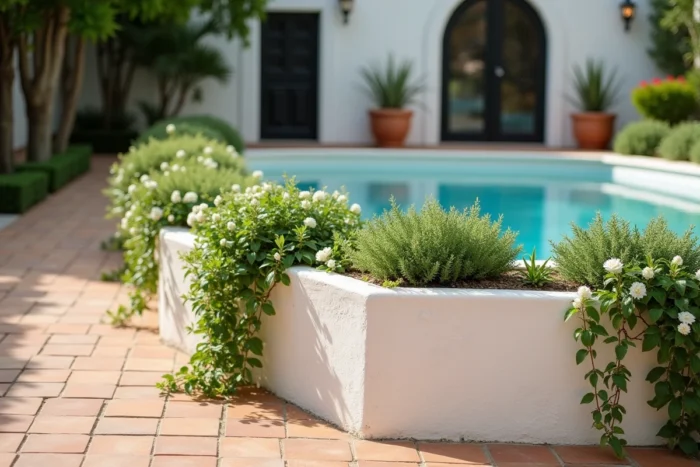
Building planters from coated concrete blocks or reconstituted stone around the basin hides the structure while creating a green setting. Cascading plants (dipladenias, ivies, petunias) gradually cover the visible wall.
This type of layout requires regular watering and a selection of plants compatible with chlorinated splashes. It is advisable to place a geotextile between the planter and the pool wall to avoid prolonged contact with moisture.
9. Shade sail combined with a wooden screen
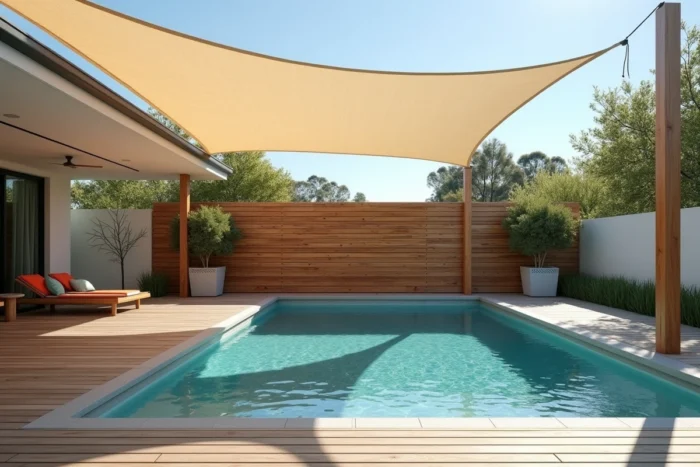
Combining a vertical screen with a shade sail creates a closed and shaded space around the basin. The screen hides the pool structure while the sail protects the water from UV rays and limits algae growth.
The fixing posts of the screen can also serve as anchor points for the sail, streamlining construction. This combination works particularly well in small gardens where peripheral space is limited.
10. Compact pool house with wooden frame
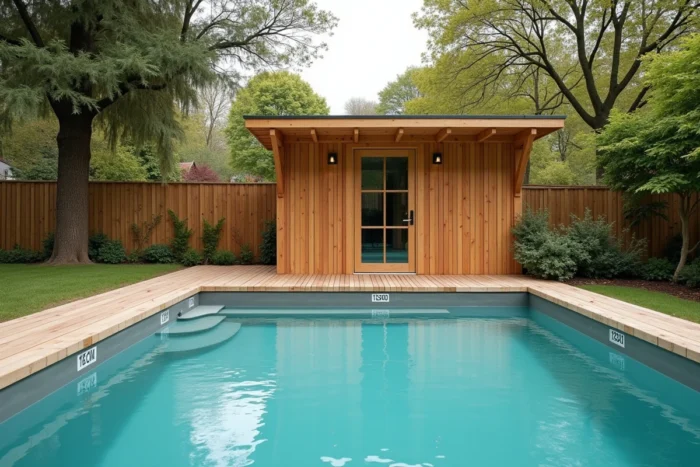
A small pool house (a few square meters) combines storage, technical room, and relaxation area. Backed against the pool, it visually integrates the basin into a coherent architectural ensemble.
Before starting, checking local urban planning regulations is necessary: beyond a certain footprint, a prior declaration of works is required. In 2026, regulations governing private pools will be strengthened, including for above-ground installations depending on configurations.
The choice of cladding depends as much on the budget and type of pool (tubular, inflatable, self-supporting) as on the expected duration of installation. Permanent solutions like composite or gabions justify their cost by the absence of maintenance, while reed or shade sails cater to seasonal use without heavy commitment.