
Tiffany & Co. is undergoing a phase of accelerated repositioning since its integration into the LVMH portfolio. Between testing lab-grown diamonds, deploying concept stores, and a high jewelry collection that reconnects with botanical vocabulary, the New York house is redefining several key aspects of contemporary jewelry.
Lab-Grown Diamonds at Tiffany: LVMH’s Strategic Shift
LVMH has begun presenting certain clients with pieces set with synthesized diamonds at prices comparable to natural diamonds. The stated goal is to gauge the high-end clientele’s appetite for a more sustainable and cost-controlled alternative.
For a house whose identity relies on the traceability of natural diamonds, this is a strong signal. Tiffany had built an entire narrative around ethical sourcing, disclosing provenance by country, and certifying each stone. Integrating synthetic diamonds into this universe requires rethinking product communication without undermining the promise of transparency.
We observe that this positioning is not aimed at replacing natural stones but at creating a parallel segment. The technical challenge lies in customer perception: a lab-grown diamond possesses the same physical and optical properties as a mined diamond, but its resale value remains significantly lower in the secondary market. Following Tiffany and Co’s recent articles allows us to measure the speed at which this strategy is unfolding across different markets.
Blue Book 2026 Hidden Garden Collection: A Jewelry Perspective
The high jewelry collection Blue Book 2026, named Hidden Garden, draws from a rich botanical vocabulary. Tiffany employs complex settings to replicate plant textures: leaf veins, overlapping petals, articulated stems.
This type of collection functions as a technical manifesto. The choice of nature as a theme is not new in high jewelry, but Tiffany approaches it here with a structural rather than decorative focus. The pieces do not merely evoke a flower: they replicate its mechanics, with joints that allow the jewelry to move like a living organism.
Positioning Against High Jewelry Competition
Major European houses (Bulgari, Van Cleef, Cartier) present their own high jewelry collections each year. Hidden Garden places Tiffany in a naturalistic register that distinguishes it from Bulgari, which is more oriented towards geometric shapes and saturated colors.
The strength of this collection lies in its ability to reaffirm the American identity of the house. While Parisian jewelers reference architecture or fashion, Tiffany invokes wild gardens, Victorian greenhouses, a more organic imagery. This cultural positioning fuels differentiation in a highly crowded high jewelry market.
Tiffany Stores as Retail Laboratories: What Changes Practically
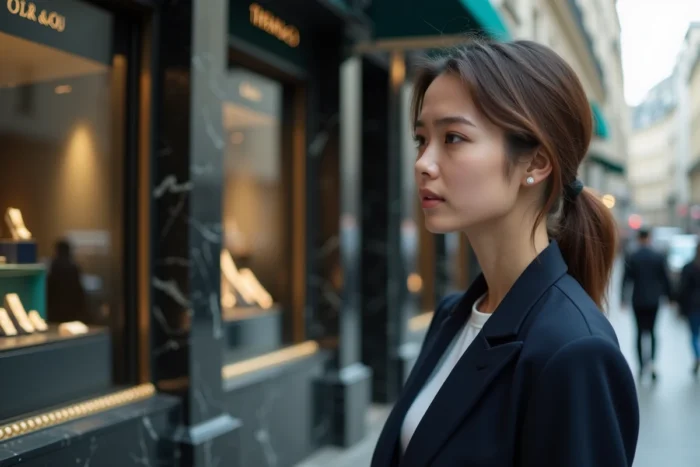
The recent openings and renovations of Tiffany stores (South Coast Plaza in the United States, Ion Orchard in Singapore) reveal a retail strategy that goes beyond mere aesthetic updates. The house uses its points of sale as retail concept laboratories integrating materials, light, and digital storytelling.
Specifically, the new spaces focus on several axes:
- The integration of raw materials (stone, wood, patinated metal) in contrast with classic displays, to create a tension between artisanal heritage and modernity
- Calibrated lighting systems by zone, with different color temperatures depending on whether silver, gold, or colored stones are being showcased
- Customization spaces where the customer participates in the configuration of their piece, with real-time digital support
This approach reflects a change in doctrine at LVMH for its jewelry houses. The group is investing in the in-store experience as a loyalty lever, at a time when the share of online sales is increasing in the luxury sector.
Customs Controls in Southeast Asia: An Overlooked Angle for Jewelry Houses
Recent news from Indonesia illustrates a rise in customs controls on international luxury houses. The friction points revolve around traceability, declared value, and documentary compliance of imported pieces.
For Tiffany, whose expansion in Southeast Asia is accelerating with new stores in Singapore and the region, this regulatory tightening has direct operational consequences. Each piece of high jewelry must be accompanied by precise documentation regarding the origin of the stones, the weight of precious metals, and the transaction value.
Impact on Tiffany’s Expansion Strategy in Asia
Houses that already master complete traceability of their supply chain, as Tiffany claims to do, have a competitive advantage in light of these new requirements. The policy of disclosing the provenance of diamonds by country of origin becomes a regulatory asset as well as a marketing argument.
We recommend monitoring the evolution of these customs frameworks in Southeast Asia. They could become a standard for other emerging markets and alter the conditions for establishing high-end jewelry stores in the region.
Advertising and Tiffany Ambassadors: The Choice of Mikey Madison
The recent campaign featuring actress Mikey Madison marks a generational renewal in Tiffany’s communication. The choice of an actress associated with independent cinema rather than a blockbuster franchise reflects a repositioning towards a clientele sensitive to alternative cultural codes.
This direction contrasts with the house’s previous campaigns, which favored celebrities with very broad audiences. By betting on more niche profiles, Tiffany seeks to capture a generation of consumers who value the perceived authenticity of the ambassador as much as raw notoriety.
The bet remains to be commercially validated, but it fits into a broader trend in luxury jewelry: associating the brand with cultural universes (cinema, contemporary art, music) rather than solely with fashion imagery. This advertising strategy participates in the same movement as the concept stores and the Hidden Garden collection, that of a house building a complete narrative ecosystem around each point of contact with the customer.