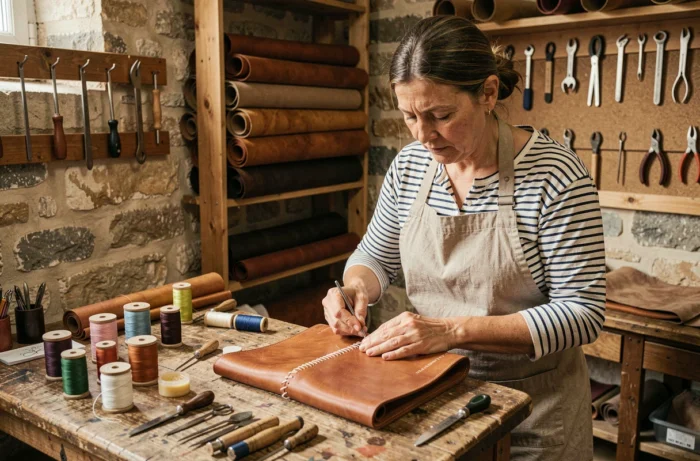
The market for handmade accessories and creations in France relies on a fabric of artisan creators with varied statuses, whose activities are governed by fiscal thresholds and reporting obligations that have significantly evolved in recent years. Between online sales platforms, local markets, and pop-up shops, this artisanal sector attracts as many enthusiasts as professional project holders.
Understanding its functioning requires moving beyond the clichéd image of “made with love” to examine the administrative, economic, and qualitative realities that structure it.
Single Window INPI and National Register: What Has Changed for Artisan Creators
Since January 1, 2023, all formalities for artisan micro-entrepreneurs go through the single window managed by the INPI. Business creation, modification, cessation: the former business formalities centers (CFE), which distinguished commerce, crafts, and liberal professions, have been replaced by this centralized platform.
The directory of trades, long an autonomous reference for artisans, has also disappeared as a distinct register. The registration of artisanal businesses, including micro-enterprises of handmade creators, is now done at the National Register of Enterprises (RNE).
This centralization simplifies administrative readability, but it has also generated technical difficulties during its implementation. Creators have reported extended registration delays and errors in activity categorization. The system has stabilized, but it remains sometimes tricky for an artisan creator to determine whether their activity falls under artisanal manufacturing or commercial sales, a distinction that conditions the applicable social regime.
Among the platforms that list independent creators in France, there are directories and specialized portals that allow direct access to each artisan’s shop, such as https://so-mauricette.fr/, which offers unique handmade accessories and creations.
Reporting Thresholds and Tax Obligations for Handmade Creators
A lesser-known point concerns the automated monitoring of sales. A report is triggered as soon as a seller exceeds 2,000 euros in annual sales or 30 transactions in the calendar year, even for small artisanal activities. This system, strengthened in recent years, targets online sales platforms that transmit this data to the tax administration.
For creators operating under the micro-enterprise regime, revenue thresholds determine the maintenance of this simplified status. The distinction between the sale of goods (manufacturing then selling accessories) and service provision (custom creation, personalization) is not trivial: the thresholds differ based on the declared nature of the activity.
Tax Considerations for an Artisan Creator
- The categorization of the activity (sale or service) directly impacts the applicable revenue threshold and the rate of social contributions.
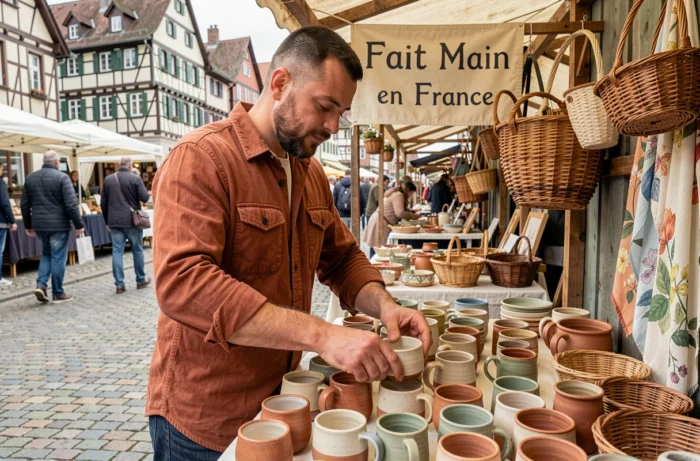
- Sales made at physical markets (creator markets, trade shows, fairs) are subject to the same reporting obligations as online sales.
- Exceeding the VAT exemption thresholds requires charging VAT, which alters the price structure and can reduce competitiveness compared to creators remaining under exemption.
Field feedback varies on the ease of obtaining clear answers from the relevant organizations. Some creators report contradictory interpretations between URSSAF and the tax service regarding the exact qualification of their activity.
Handmade Accessories in France: Materials, Techniques, and Traceability
Beyond the administrative framework, the value of a handmade accessory lies in the choice of materials and technical mastery. French creators work with a wide variety of materials: fabrics (cotton, linen, wool), leather, wood, resin, metal, ceramics. The traceability of raw materials remains a weak point in the artisanal sector, due to the lack of mandatory standards comparable to those of conventional textile industry.
A creator who claims to use “organic cotton” or “vegetable leather” is not subject to any specific mandatory certification for handmade products. Existing labels (GOTS for organic textiles, for example) are designed for industrial volumes and remain costly for a micro-entrepreneur. In practice, trust relies on the individual transparency of the artisan: workshop photos, supplier descriptions, explanations of processes.
Most Common Artisan Techniques
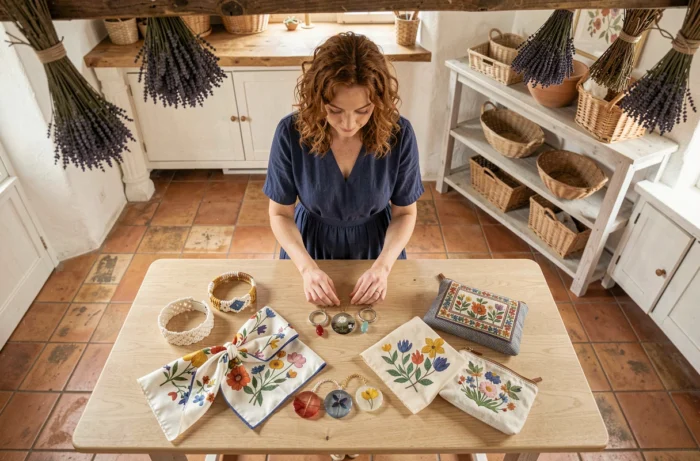
Sewing, crochet, knitting, embroidery, leatherwork, woodturning, ceramic modeling: each technique requires an investment in materials and training. The manufacturing time of a handmade accessory far exceeds that of an industrial product, which explains higher unit prices but also often superior durability.
The question of training is a subject in itself. Many creators are self-taught. Others go through CAP (crafts, leather goods, sewing) or short training courses offered by trade chambers. The available data does not allow for conclusions about the direct impact of a diploma training on the economic viability of a handmade creator’s activity.
Creator Markets and Online Sales: Two Channels with Different Logics
Creator markets, whether occasional or recurring, offer direct contact between the artisan and the buyer. This direct relationship without intermediaries remains a strong argument: the customer sees the piece, exchanges with its creator, understands the manufacturing process.
In contrast, online sales expose creators to broader competition where visibility depends as much on product quality as on mastery of SEO, photography, and social media. An artisan excelling in their craft can remain invisible due to a lack of digital skills.
- At a physical market, the creator controls the presentation, pricing, and narrative. Costs are limited to space rental and travel.
- On an online platform, commissions, shipping fees, and return policies alter the actual margin on each sale.
- Specialized directories and portals for French creators provide an intermediate path, redirecting to the artisan’s own shop rather than a centralized marketplace.
The choice between these channels is not binary. Most viable creators combine local physical presence with an online shop, adjusting the distribution according to seasonality and customer type.
The world of handmade accessories in France lies at the crossroads of real artisanal know-how and a changing regulatory framework. The centralization of procedures through the single window INPI and the thresholds for automatic reporting outline a more structured environment than a few years ago. For the buyer, the main guarantee remains the direct relationship with the creator and transparency regarding materials and manufacturing processes.