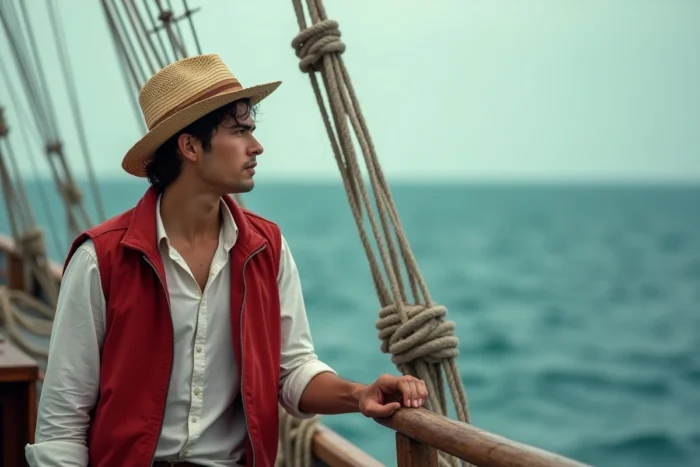
Eiichiro Oda does not build a classic fantasy universe. The geography of One Piece, its institutions, its conflicts are based on a tight weaving of real historical references, disparate mythologies, and narrative constraints embraced by the author himself. Understanding this mechanism changes the reading of the manga well beyond the simple question of the final treasure.
Staging Constraints in One Piece: Why Oda Refuses Air Travel
Oda has explained his desire to keep One Piece focused on the sea and navigation. This choice, often seen as a mere aesthetic bias, is rooted in a structural logic. The sea imposes a narrative tempo that air travel would destroy: crossing times, unpredictable weather of the Grand Line, random encounters between crews.
This constraint produces concrete effects on the narrative. The Devil Fruits, which remove the ability to swim, would be just a minor handicap in a world where one travels by air. The ocean remains the only force that universally threatens every character, including the most powerful. Removing the sea from the center of the plot would neutralize the vulnerability system on which all dramatic tension relies.
The few characters capable of flying (Marco, King) never change the group dynamic. Oda confines their aerial abilities to battle scenes, never to travel logistics. For those who wish to explore the universe of One Piece in detail, this mechanism of voluntary restriction sheds light on narrative choices that lore guides focused on mysteries systematically ignore.
Real History and Mythology: The Sources Oda Weaves into Each Arc
In One Piece, we observe a process that few shonen manga push this far: each arc reflects an identifiable event or mythological cycle. Alabasta borrows from ancient Egypt and dynastic succession conflicts. Skypiea transposes the Spanish conquest of pre-Columbian civilizations, with the Shandians as a people dispossessed of their sacred land.
The Wano arc takes the structure of feudal Japan under isolationism (sakoku), with a tyrannical shogun supported by an external power. The figure of Oden Kozuki blends the myth of the wandering samurai and the archetype of the sovereign sacrificed for historical truth.
Davy Jones and Real Piracy in the New World
The Davy Back Fight is not a pure invention. Betting rituals between pirate crews existed in the Caribbean in the 17th century. Oda takes these documented practices and distorts them just enough to fit the tone of the manga without losing their grounding.
The figure of Davy Jones himself, omnipresent in Anglo-Saxon maritime folklore, permeates several layers of the narrative. Rocks D. Xebec carries a name that evokes both a type of Mediterranean ship (the xebec) and an ambition for oceanic domination predating Roger. Oda never directly cites his sources, but the clues are readable enough for those familiar with the history of piracy.
The Lost Century and the Fabrication of Truth in the World of One Piece
The World Government has erased a hundred years of history. This narrative postulate is not merely a plot device. Oda reproduces the real mechanism of Roman damnatio memoriae, where the ruling power methodically destroys traces of a predecessor deemed dangerous.
The Poneglyphs function as indestructible steles, analogous to cuneiform inscriptions or hieroglyphs that successive conquerors have failed to erase. The fact that only the descendants of Ohara and a few rare scholars can read them reproduces the historical dynamic of the loss of ancient languages.
The One Piece as Material Truth, Not as a MacGuffin
For years, the community treated the One Piece as a mere quest objective, a pretext to justify Luffy’s journey. Recent statements from Oda and the clues accumulated in the manga reposition the treasure as a real object bearing a truth about the Lost Century.
Roger laughed upon discovering it. This detail, repeated by Oda, suggests that the One Piece is neither a weapon nor a mountain of gold. We believe that Roger’s reaction reflects the discovery of a historical irony, likely related to the nature of the World Government and what it has tried to erase.
- The Poneglyphs constitute the physical evidence of erased knowledge, deliberately scattered so that no single entity can reconstruct the truth
- Roger’s laughter implies a disconnect between what the world believes and what the treasure reveals, which dismisses purely material theories
- Joy Boy, a figure linked to the One Piece, bears a name that refers to an unfulfilled promise, rooted in a pact between civilizations of the Lost Century

Oda and the Management of Long Time: Why One Piece Ages Better Than Its Competitors
A manga published since the late 1990s and still capable of producing revelations consistent with its early chapters is a unique case in shonen. Oda plants narrative seeds sometimes hundreds of chapters before their resolution.
The character of Crocodile in Alabasta receives different treatment during the Marineford war. This is not a retcon: Oda left enough ambiguity in the initial characterization for the evolution to seem organic. This process, applied to dozens of characters and subplots, distinguishes One Piece from series that improvise their mythology as arcs progress.
The longevity of the manga also relies on its geographical structure. Each island of the Grand Line functions as a closed world with its own rules, its own conflict, its own aesthetics. This compartmentalization allows Oda to renew the narrative without starting from scratch, while accumulating the threads that converge towards Laugh Tale.
The Straw Hat crew traverses a world where truth is a rare commodity, held by those who read the stones, and the final treasure will likely not be a reward but a revelation. It is this architecture, patient and deliberate, that makes One Piece more than just a pirate adventure.