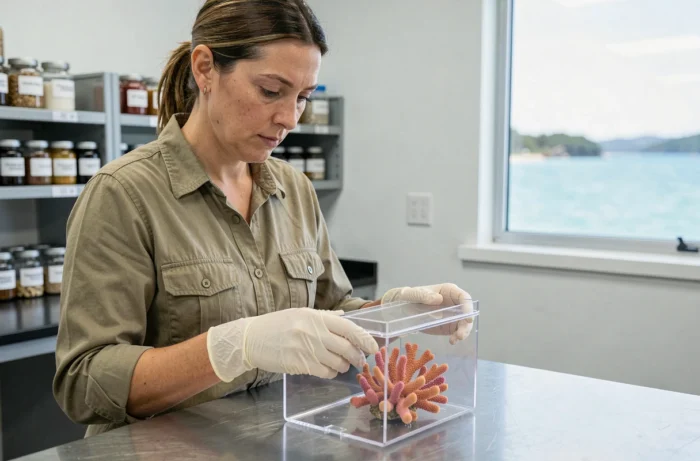
Australian coral, whether dead or alive, falls under a legal framework that intersects environmental law, customs regulations, and international conventions. Any attempt to transport it by air without understanding this framework exposes one to the seizure of the specimen and criminal prosecution.
Export Control Rules 2021 and classification of coral as prescribed fish product
Coral exported from Australia by air is legally classified as prescribed fish products under the Export Control (Fish and Fish Products) Rules 2021, administered by the Department of Agriculture, Fisheries and Forestry. This classification applies equally to live coral intended for aquaristics and dead coral sold as decorative objects.
The export procedure imposes three distinct obligations. The establishment handling or preparing the coral for export (producer, processor, freight forwarder, warehouse) must be registered with the Department. Each shipment requires an export permit issued via the NEXDOC system, linked to product codes used in customs and air freight systems. Finally, a compliance declaration accompanies each shipment, certifying that the product meets the Rules 2021 and the health requirements of the importing country.
We observe that most travelers confuse this commercial procedure with a simple customs check. An individual slipping a fragment of coral into their luggage is not exempt: they must be able to justify the lawful origin of the specimen and its compliance with export rules. Understanding the regulations for transporting coral in Australia before departure avoids serious complications at the airport.
CITES, permits, and distinction between dead and live coral
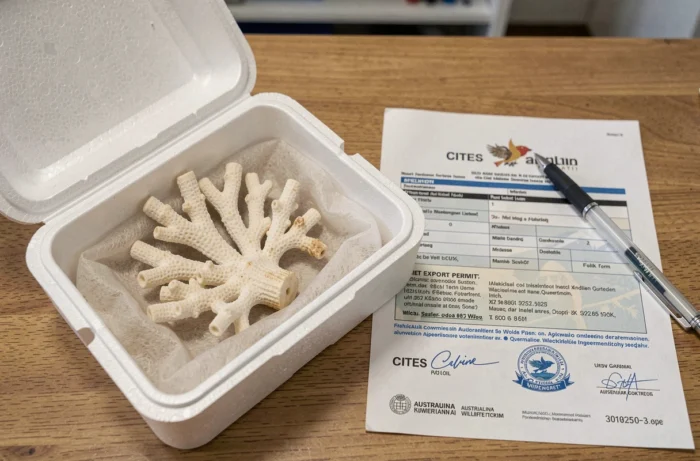
All hard corals (order Scleractinia) and nearly all soft corals are listed in the CITES appendices (Convention on International Trade in Endangered Species of Wild Fauna and Flora). Australia implements this convention through the Environment Protection and Biodiversity Conservation Act 1999 (EPBC Act), which subjects the export of CITES specimens to a specific federal permit, distinct from the “fish product” export permit.
The distinction between dead and live coral does not alleviate the administrative burden, contrary to popular belief. A piece of bleached coral collected from a beach remains a CITES specimen. A dead coral requires the same type of CITES permit as a live coral.
The only difference lies in the transport conditions: live coral requires packaging that complies with IATA standards for aquatic organisms (Live Animals Regulations), while dead coral falls under standard freight or checked baggage.
Specific case of the Great Barrier Reef Marine Park
Any collection of coral within the boundaries of the Great Barrier Reef Marine Park is subject to authorization issued by the Great Barrier Reef Marine Park Authority (GBRMPA). This authorization is in addition to CITES permits and Export Control Rules. In practice, the GBRMPA issues very few collection permits for personal purposes. Authorizations are typically for scientific research or licensed commercial operators.
Customs declaration obligations when departing Australia
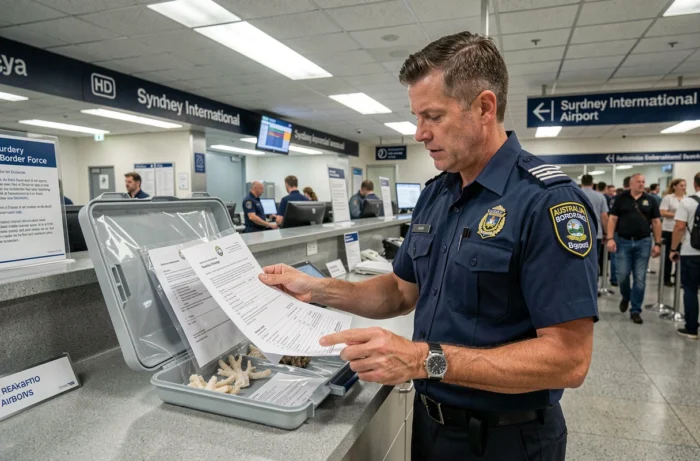
The Australian Border Force (ABF) checks luggage for export. Any traveler leaving Australian territory with an animal or plant product must declare it on the departure card. Coral falls into this category, whether raw, polished, or set into jewelry.
Biosafety officers at the airport have scanners and sniffer dogs trained to detect organic materials. Undeclared coral results in immediate seizure and a fine that may be accompanied by criminal prosecution.
- Mandatory declaration on the departure form, even for a fragment of a few centimeters
- Presentation of the CITES permit and export permit if the specimen exceeds strictly personal use (which is still heavily regulated)
- Retention of proof of purchase from a licensed seller, the only way to demonstrate the lawful origin of the coral
IATA conditions for air transport of live coral
The transport of live coral by air freight falls under the IATA Live Animals Regulations (LAR). These standards require watertight containers, appropriate oxygenation, and temperature maintenance throughout the journey. Australian airlines, including Qantas Freight, apply specific protocols for seafood and live aquatic organisms.
An individual cannot carry live coral in their cabin baggage or standard hold. Live transport must go through a certified freight operator, who has export registration and compliant packaging equipment. We recommend checking the specific requirements of the chosen airline, as some refuse any live organisms outside of cargo freight.
Arrival in the destination country
Obligations do not stop upon departure from Australia. The importing country applies its own CITES and health rules. In France, for example, the General Directorate of Customs requires the presentation of the Australian export CITES permit and may request a separate import permit. Coral arriving without complete documentation will be seized by French customs.
- Check the CITES requirements of the destination country before departure
- Ensure that the Australian export permit is accepted by the CITES authority of the arrival country
- Anticipate a delay of several weeks for obtaining import permits in some European countries
Sanctions and remedies in case of infringement
Australia imposes heavy penalties for trafficking in protected species. The EPBC Act provides for significant fines for unauthorized export of CITES specimens, with aggravated penalties when the collection occurred in a protected area such as the Great Barrier Reef Marine Park.
Good faith is not a valid defense in Australian courts regarding illegal trade in protected species. A tourist who buys coral at a local market without verifying the legality of the transaction faces the same penalties as an undeclared professional exporter.
The only reliable way to transport coral when leaving Australia by air is to purchase from a licensed seller, who holds the necessary permits and can provide complete CITES documentation. Any other scenario poses a legal risk that we strongly advise against.