
You just picked up your prescription from the ophthalmologist, and the numbers on the sheet don’t really make sense to you. However, these values directly determine the thickness of your future glasses lenses, their weight on your nose, and the final appearance on your face. Understanding a few simple principles is enough to make an informed choice, without solely relying on the optician’s sales pitch.
Lens refractive index: the parameter no one details for you
When it comes to lens thickness, everything revolves around a single technical number: the refractive index. The higher this index, the more effectively the material bends light. The lens can then be thinner for the same correction.
In practical terms, a standard index lens (1.5) is suitable for low corrections. As the correction increases, the lens quickly becomes thicker. Switching to a higher index (1.6, 1.67, or even 1.74) significantly reduces this thickness.
You may have noticed that some people wear glasses with very thick lenses despite a thin frame? This is often due to a poorly chosen index that doesn’t match the correction. An index that is too low for high myopia results in prominent lens edges. Conversely, for a light correction, investing in a very high index makes almost no visual difference.
To estimate the thickness of your lenses before placing an order, the lens calculator on Pharmidea allows you to compare results based on different indices and visualize the differences.
Myopia and hyperopia: thickness does not distribute in the same place
A myopic lens is thinner in the center and thicker at the edges. A hyperopic lens is the opposite: thick in the center, thin at the edges. This difference changes the strategy.
For a myope, a small frame mechanically reduces the visible thickness, because it cuts off the thick edges. For a hyperope, the size of the frame matters less: it is mainly the index that affects the appearance at the center of the lens.

Frame size and shape: an often underestimated lever for thickness
The refractive index is not everything. The frame influences the final thickness as much as the lens material. This is a point that many wearers discover too late, once the glasses are assembled.
A wide frame requires cutting a larger lens. For a myope, this means thicker edges. Choosing a frame with a moderate lens width is the most cost-effective way to limit thickness, even before upgrading the index.
The centering of the lens in the frame
Your optician centers the lens on your pupil. If your pupillary distance is narrow and the frame is wide, the optical center is offset from the middle of the lens. The result: a noticeably thicker edge on one side.
Here are the concrete criteria to check when choosing your frame:
- The lens width (the size of the lens in the frame): aim for a width consistent with your pupillary distance, not the largest frame on display
- The shape of the lens: round or oval shapes distribute thickness better than very rectangular shapes, especially for myopes
- The thickness of the rim: on a thick acetate frame, the edges of the lens are concealed by the frame material, which reduces the “bottle bottom” effect
A thick acetate frame can make a medium index lens as discreet as a high index lens in a thin frame. This is a less expensive alternative to maximum thinning.
Thick acetate frames and the 2025 trend: an ally for strong corrections
Current eyewear trends favor wearers with strong corrections. Thick, sculpted acetate frames, whether oversized, tortoiseshell, or transparent, are making a comeback.
Beyond aesthetics, these frames offer a concrete technical advantage. Their wide rim envelops the edges of the lens. A slightly thicker lens visually disappears in a thick frame. This means that it is not always necessary to choose the highest (and most expensive) index to achieve a satisfactory aesthetic result.
For myopes with a correction beyond four or five diopters, combining an acetate frame with an intermediate index (1.6 or 1.67) often represents the best compromise between price, weight, and appearance.
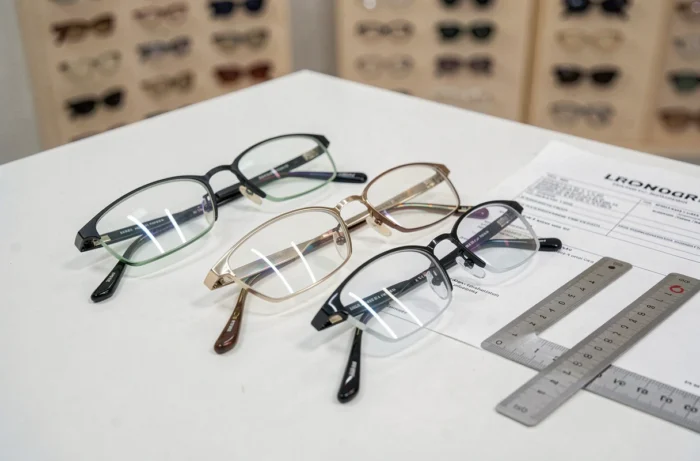
Protective corrective glasses: a minimum thickness constraint to know
If you wear protective glasses at work with corrective lenses, the choice of thickness follows different rules. The standard EN ISO 16321, which is gradually replacing the old EN 166, imposes mechanical resistance requirements on lenses.
The lenses must withstand impact tests (markings F, B, or A depending on the level of protection). This mechanical constraint imposes a minimum thickness that aesthetic thinning cannot circumvent.
For affected wearers:
- The very high index (1.74) may not be compatible with certain resistance requirements, as a very thin lens is more fragile to impacts
- Polycarbonate, a lightweight and impact-resistant material, is often preferred in this context, even if it does not offer the best optical quality
- The choice is then between mechanical protection and lens thinness, not just based on aesthetic criteria
In a professional setting, the standard takes precedence over aesthetics. Check with your optician that the chosen material is compatible with the level of protection required by your employer.
Choosing the thickness of your lenses: summary of trade-offs
The choice of thickness for your glasses lenses depends on three interacting variables: your correction, the refractive index of the lens, and the frame. None of these variables operates in isolation.
For light corrections, a standard lens with a well-chosen frame is sufficient. For medium to strong corrections, combining an appropriate index with a frame that conceals the edges yields the best result at the best price. Wearers of protective glasses must also consider the normative constraint in their decision-making.
The most common pitfall remains focusing solely on the index while ignoring the frame, or paying for the maximum index when the correction does not justify it.