The market for brush cutters today offers dozens of thermal, electric, and battery models. In light of this offering, the real selection criteria go far beyond just power. Vibrations, local noise regulations, cutting system, user protection: several technical parameters deserve careful analysis before any purchase.
Vibrations and prolonged exposure: the criterion that comparisons overlook
Most buying guides rank brush cutters by engine power or type of motorization. The vibrations transmitted to the hands and arms are rarely included in the comparison, even though they directly affect the duration of use possible without health risks.
The French regulations set a daily action value of 2.5 m/s² and a limit value of 5 m/s² (articles R. 4443-1 and R. 4443-2 of the Labor Code). A model advertised as comfortable does not eliminate this risk. The duration of continuous use and breaks remain crucial, regardless of the type of handle or cutting head installed.
In practice, vibration values vary depending on the handle/cutting head combination. A bar handle with a grass blade will not produce the same level as a loop handle with a nylon line. Before purchasing, check the manufacturer’s technical sheet for this data, often mentioned in Stihl manuals or on AgriEuro sheets, and compare it to your expected duration of use.
Thermal or battery brush cutter: the data that really matters
The choice between thermal and battery structures the majority of online searches. To answer this with concrete data from recent comparisons, here are the observed differences in consumer models:
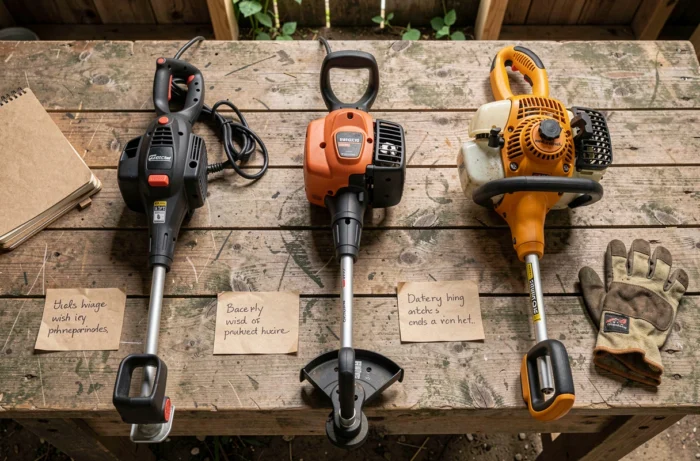
- In real power, two-stroke thermal engines (35 to 50 cm³) develop between 1.2 and 2.5 kW, while 36V/54V batteries range from 0.8 to 1.5 kW. The difference is felt on dense vegetation, brambles, and wastelands.
- The average weight of a thermal model ranges from 6 to 9.5 kg, compared to 3.5 to 5.5 kg for a battery model. On a slope or during prolonged use, this difference affects the perceived fatigue.
- The noise level is the most significant difference: from 95 to 105 dB for a thermal model, compared to 67 to 85 dB for a battery. This point is not just a comfort criterion; it directly relates to local regulations.
- The maintenance of a thermal model (spark plugs, filters, oil/gas mixture) is significantly more demanding than that of a battery model, which requires almost no maintenance.
Field feedback varies on the durability of batteries after several seasons. A 36V battery model, such as the Bosch AdvancedGrassCut 36, offers a weight/power ratio comparable to 25 cm³ thermals, but the question of the end-of-life for lithium-ion batteries remains open in terms of recycling and replacement costs.
For forested areas or dense wastelands, a thermal model with a 40 to 50 cm³ engine retains the advantage of unlimited autonomy. Several tests indicate that a model equipped with a Honda GX35 engine remains a benchmark in this category. The resources available on Ma débroussailleuse – Comparison 2017, tests, and reviews detail user feedback on these engines.
Local noise regulations: an underestimated purchasing parameter
There is no single national time frame for the use of brush cutters. Authorized hours are set by municipal or prefectural decree and can be more restrictive from one municipality to another. Before comparing the noise levels of models, check your town hall or prefecture’s website.
This reality changes the game for choosing motorization. In a residential area with reduced time frames (typically Saturday mornings and a few hours during the week), a 70 dB battery model offers much greater flexibility of use than a 100 dB thermal model, even if the cutting power is lower. The noise criterion then becomes a usage criterion, not just a comfort one.
Safety and debris projection: nylon line, blade, and clearance distance
The choice of cutting system (nylon line, grass blade, brush blade) is not limited to the type of vegetation. It also determines the risk of projection.
The manuals for the professional models Stihl FS 460 and FS 490 C-M specify a minimum clearance of 15 meters around the machine, with the note that some objects can be projected beyond this distance. This parameter must be related to the terrain configuration: a fenced garden bordering a pedestrian path requires different precautions than an isolated agricultural field.
The recommended personal protection for regular use includes:
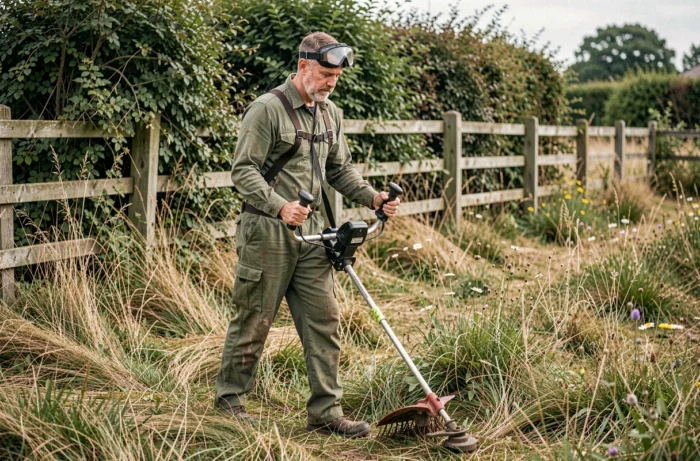
- Eye and face protection (full visor preferred)
- Hearing protection suitable for the noise level of the model
- Gloves, reinforced pants, and high safety shoes
The harness plays a dual role: it distributes weight to limit back fatigue and stabilizes the machine to reduce uncontrolled movements. A double-strap harness provides better balance than a single harness, especially on thermal models weighing over 7 kg.
Choosing your brush cutter based on surface area and actual vegetation
A residential garden of a few hundred square meters with tall grass and borders does not require the same machine as a sloped area covered with brambles. The vegetation to be cut determines the cutting system, and the surface area determines the necessary autonomy.
For edging finishes and soft grass, a battery trimmer is sufficient. As soon as the vegetation includes woody stems or brush, a brush cutter with a blade becomes necessary. Mid-range thermal models (around 35 cm³) cover the majority of mixed uses in uneven terrain.
The common trap is to buy an overpowered machine for occasional use. A 50 cm³ model in a small flat garden generates excessive weight, disproportionate noise, and unnecessary maintenance. Conversely, a wired electric trimmer on a sloped area of 1,000 m² quickly becomes impractical.
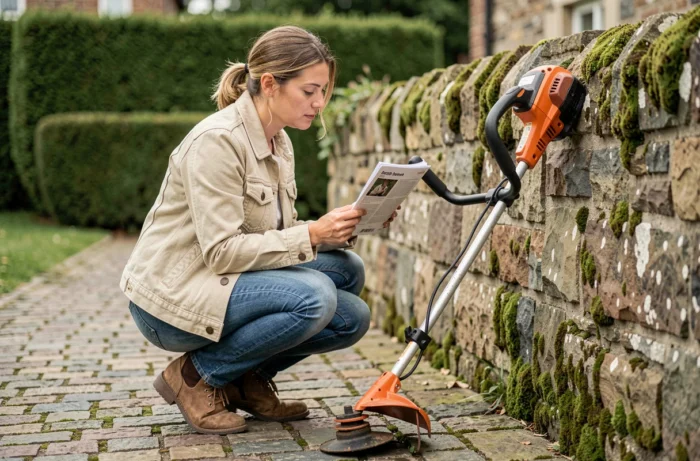
Every purchase should start with a precise inventory: type of vegetation, surface area, elevation, proximity of neighbors, frequency of use per season. These five parameters are enough to eliminate the majority of unsuitable models and narrow the choice down to two or three relevant machines.