The julienne of vegetables relies on a precise gesture: transforming a vegetable into regular sticks about one millimeter in cross-section and a few centimeters long. This cut, inherited from the classical vocabulary of French cuisine, conditions both the texture in the mouth and the uniformity of cooking. Mastering this cutting technique requires less innate dexterity than method, starting with the stability of the workstation and the choice of the right tool.
Stability of the board and preparation of the vegetable before julienne cutting
Before even touching a knife, the work surface must be reliable. A board that slips under the blade generates uneven cuts and increases the risk of injury. The simplest solution is to place a damp cloth under the board to secure it on the work surface.
The vegetable itself needs a stable base. A carrot or zucchini naturally rolls on a flat surface. To remedy this, a thin slice is first removed along its length to create a flat base. This flat side prevents the vegetable from pivoting under the pressure of the blade and ensures slices of consistent thickness.
A often overlooked point concerns the condition of the board. Those with deep scratches or marked cracks can harbor food residues that are difficult to clean. According to advice shared by Top Santé, a heavily scratched or odor-imbued board should be replaced, especially if it is also used for foods consumed raw. Separating the board dedicated to vegetables from the one used for raw meat remains a basic hygiene precaution.
Those wishing to deepen their technique can consult how to cut julienne on À Nos Petits Fourneaux, where the knife technique is detailed step by step.
Knife technique: cutting regular sticks
The chef’s knife remains the reference tool for julienne. Its long and slightly curved blade allows for a smooth rocking motion. A well-sharpened knife slices through the fibers instead of crushing them, preserving the stick’s integrity during cooking.
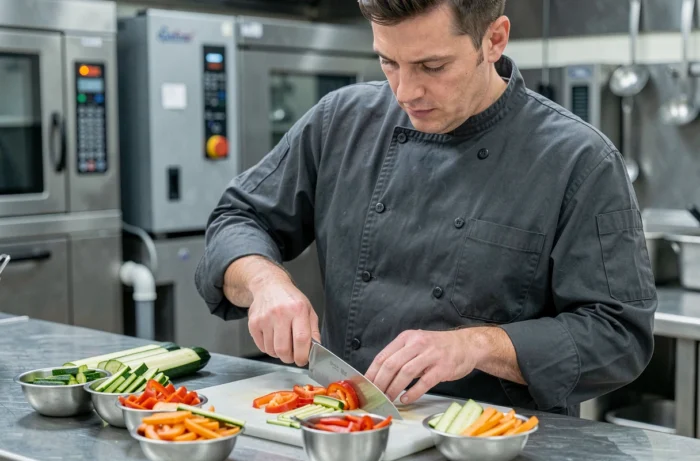
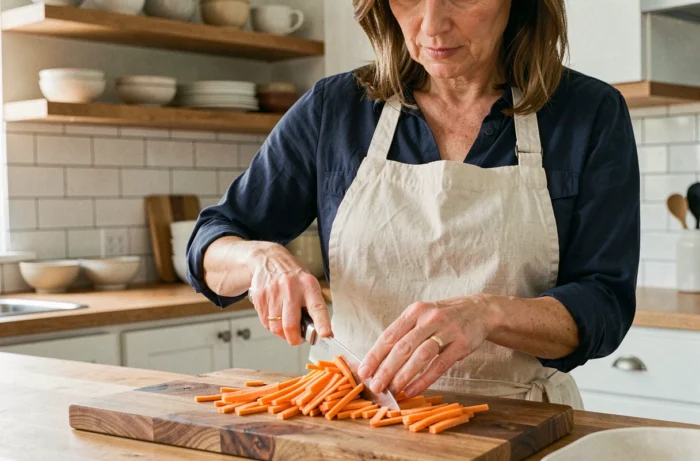
The method is broken down into two stages. First, the vegetable is cut into sections a few centimeters long, then each section is sliced into thin strips lengthwise. These strips are then stacked and cut again into thin sticks.
- Keep the fingers curled in a claw shape over the vegetable, with the knuckles serving as a guide for the blade to avoid cuts.
- Keep the heel of the knife in contact with the board and tilt the blade forward rather than lifting the knife entirely with each cut.
- Adjust the thickness of the first slices to the desired thickness for the sticks: if the strips are two millimeters, the sticks will be two millimeters in cross-section.
Consistency takes precedence over speed. Sticks of uniform size cook evenly, preventing a mix of al dente pieces and overcooked pieces in the same pan.
Mandoline and safety: saving time without injury
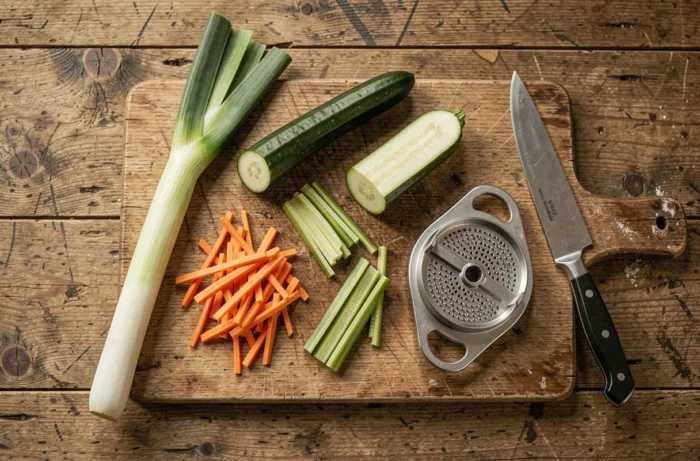
The mandoline significantly speeds up the work. It produces slices of consistent thickness in seconds, where the knife requires concentration on each cut. For julienne, the blade is first set to the desired thickness, the vegetable is passed through once to obtain strips, then stacked and sliced with the knife, or the julienne grid is used directly if the mandoline is equipped with one.
The safety pusher is not an optional accessory. A guide dedicated to the use of the mandoline, updated in August 2026, emphasizes the necessity of using it consistently. It also recommends slowing down the motion and stopping the cutting before reaching the last small portion of the vegetable, which is too difficult to hold properly against the blade.
However, the mandoline shows its limits on very hard or irregularly shaped vegetables. A whole celeriac, for example, benefits from being first trimmed with a knife into rectangular blocks before going through the blade. Forcing a poorly sized vegetable on the mandoline distorts the slices and reduces the uniformity of the julienne.
Oxidation and preservation of julienne-cut vegetables
Once cut, some vegetables brown within minutes when exposed to air. Potatoes and artichokes are the most sensitive to this oxidation. Immersing them immediately in a cold water bath limits browning and preserves their appearance.
This step, however, has a downside. An excess of residual water causes steaming rather than a crisp browning. Thoroughly drain the sticks and then dry them on a clean cloth before sending them into the pan or wok makes all the difference between crispy vegetables and mushy ones.
Carrots, zucchinis, and peppers tolerate waiting in the open air better, but gradually lose their firmness. Preparing the julienne as close to the cooking time as possible remains the best way to preserve the texture and nutritional qualities of the vegetables.
Adapting the cut to the type of vegetable and the recipe
Not all vegetables react the same way to julienne. Root vegetables (carrots, parsnips, turnips) offer a dense flesh that lends itself well to fine sticks: they maintain their shape during cooking and provide crunch. More watery vegetables like zucchini or cucumber release more water and are better suited for raw preparations or very brief stir-fries over high heat.
- For a soup, slightly thicker sticks cook without disintegrating in the broth.
- For spring rolls or nems, a very fine julienne facilitates rolling and biting.
- For a stir-fry in a wok, an intermediate thickness allows for maximum contact with the hot surface without the sticks breaking.
The choice of thickness depends as much on the vegetable as on the intended cooking method. Adjusting this parameter from the start avoids having to compensate with approximate cooking times.
The julienne remains a fundamental gesture that, once mastered, applies to almost all everyday vegetables. Precision comes with repetition, not speed. A good sharpening of the knife, a stable board, and thorough draining after cutting do more for the final result than any additional gadget.