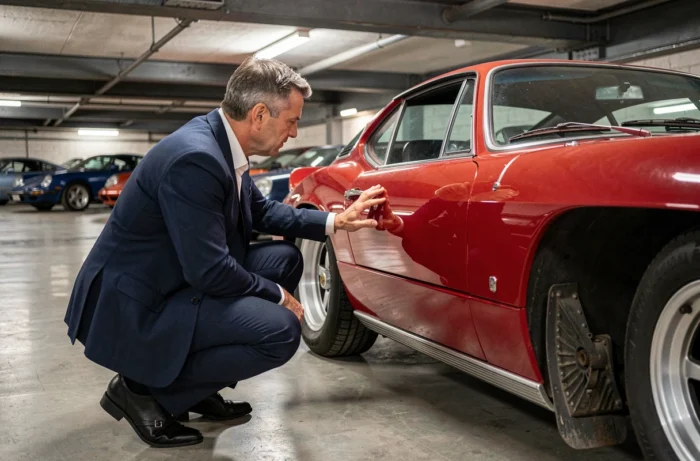
What distinguishes a rare car from an exceptional car? The answer often lies in three measurable parameters: the production volume, the ability to maintain or increase its value in the secondary market, and the growing difficulty of maintenance. The market for collectible and exceptional cars saw notable activity in 2025, far beyond just the most publicized Ferrari, Bugatti, and Porsche. Understanding this automotive universe requires looking at the data before the legends.
FFVE Certificate and Classic Registration: The Real Administrative Journey
Most articles on exceptional cars focus on performance and design. The daily life of an owner begins with paperwork. For a vehicle over thirty years old to obtain the “classic” designation on its registration, it must first go through a certificate issued by the FFVE (French Federation of Vintage Vehicles).
This document certifies that the model has historical or technical interest. FFVE fees have actually increased as of October 1, 2026, a signal that the demand for classic registrations remains strong.
Once the designation is obtained, the vehicle benefits from concrete advantages: exemption from the standard periodic technical inspection (replaced by a less frequent specific inspection), the possibility of driving with black plates, and especially potential exemptions in low-emission zones. Automobile enthusiasts who wish to deepen their knowledge of vintage models and remarkable vehicles can find specialized resources on automaniacs.be, particularly to guide their research before a purchase.
Low-Emission Zones: Exemptions for Classic Vehicles
The traffic rules in low-emission zones are the most anxiety-inducing topic for owners of vintage cars. Classic vehicles are often excluded from the Crit’Air classification or classified among the most restrictive categories.
Exemptions are not uniform from one metropolis to another. Each community sets its own conditions. The European Metropolis of Lille, the Eurometropolis of Strasbourg, and the Metropolis of Lyon apply distinct frameworks.
| Criteria | Vehicle with “classic” designation | Old vehicle without designation |
|---|---|---|
| Crit’Air Classification | Often unclassified (exemption possible) | Crit’Air 4 or 5, or even unclassified (no exemption) |
| ZFE Access | Variable depending on the community, exemption to be checked locally | Prohibited in most active ZFEs |
| Technical Inspection | Specific regime, less frequent | Mandatory standard inspection |
| License Plates | Black plates allowed | Standard SIV plates |
The distinction is clear: the classic registration opens rights that the mere age of the vehicle does not confer. An owner of a 1970s Porsche 911 without classic designation risks being denied access to the city center, where the same model with the designation would circulate under exemption.
Finding a Mechanical Specialist: The Real Bottleneck
The increase in transactions in the exceptional car market is accompanied by a concrete problem: the lack of qualified professionals to maintain vintage models. Skills in specific mechanics, spare parts, and technical documentation are becoming scarce as artisans retire.
The FFVE launched a dedicated platform in 2026 to help owners find a specialist, according to Auto Journal. This initiative reflects the extent of the need.
What Makes Maintenance Complex for Exceptional Models
- Original parts are no longer manufactured for the majority of models produced before the 1990s. Each intervention requires locating an existing stock or having a part custom-made.
- Technical documentation (wiring diagrams, torque specifications, machining dimensions) is not digitized for many brands, and paper manuals circulate among private collectors.
- Skills in carburetors, mechanical ignition, or Bosch mechanical injection are transmitted less and less in standard automotive training, which is focused on electronics and hybrids.
For a Lamborghini or Ferrari model from the 1980s, the cost of maintenance is less about the price of parts and more about the rarity of skilled hands capable of fitting them correctly. A competent specialist protects the value of the vehicle as much as the vehicle itself.

Secondary Market for Exceptional Cars: Beyond the Leading Brands
Ferrari, Porsche, and Bugatti capture media attention. However, the secondary market for exceptional vehicles extends well beyond these three names. Models produced in very limited series by Aston Martin, Koenigsegg, or even certain special series from mainstream manufacturers are experiencing remarkable value trajectories.
The market activity in 2025 affected less expected segments. Vehicles considered “youngtimers” (models from the 1990s and 2000s) are beginning to cross the thirty-year threshold and become eligible for the classic designation. This shift alters their tax status and accessibility in low-emission zones, directly influencing their value.
Criteria That Determine the Value of an Exceptional Vehicle
Design and history matter, but savvy buyers first look at traceability. A complete maintenance log, dated restoration invoices, and consistency between the chassis number and mechanical components weigh more heavily than a prestigious brand name on a poorly documented model.
A well-documented exceptional vehicle sells more easily than a rare model without history. The time when purchases were made “on gut feeling” in a swap meet parking lot is over. The industry is professionalizing, driven by FFVE platforms and specialized automotive concierges.
The market for collectible and exceptional cars remains a universe where passion guides the purchase, but where regulatory constraints and the scarcity of mechanical skills are redefining priorities. The classic registration is no longer just an aesthetic advantage with its black plates: it has become a tool for heritage protection against increasing traffic restrictions.