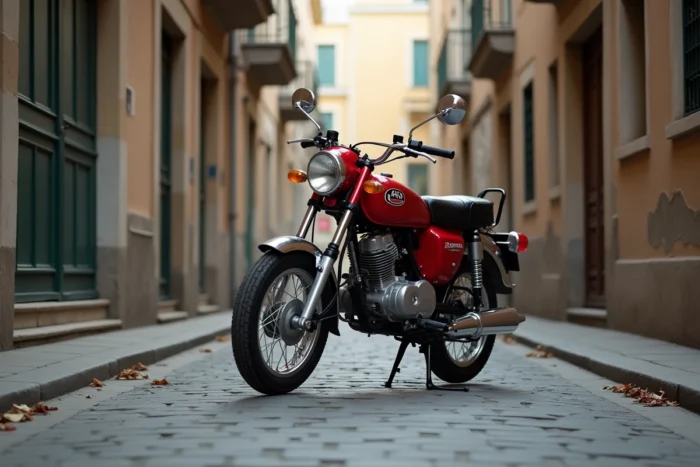
The Dax ST 125 boasts attractive specifications on paper: a single-cylinder 4-stroke engine, a 4-speed gearbox, centrifugal automatic clutch, and a manageable weight. The question before purchase is less about style (which is universally praised) and more about what this small engine actually delivers in real-world conditions, as well as the maintenance budget to anticipate over the kilometers.
Dax ST 125 vs. Monkey 125 and Skyteam clones: compared technical data
Most product sheets detail the Dax in isolation. Comparing its features with those of its direct alternatives helps better understand what you are buying.
| Criterion | Honda Dax ST 125 | Honda Monkey 125 | Skyteam Dax 125 (clone) |
|---|---|---|---|
| Engine architecture | Single-cylinder 4T, single cam, 2 valves | Single-cylinder 4T, single cam, 2 valves | Single-cylinder 4T |
| Gearbox | 4 speeds, centrifugal clutch | 5 speeds, manual clutch | 4 speeds (semi-auto depending on versions) |
| Wheels | 12 inches | 12 inches | 10 to 12 inches depending on the model year |
| Fork | Inverted ø 31 mm | Inverted ø 31 mm | Conventional |
| Homologation | Euro5+ | Euro5+ | Euro5 (variable) |
| Two-seater | Yes (passenger handle) | No (single-seater) | Variable depending on the model |
Several elements stand out from this table. The Dax ST 125 is the only two-seater in the Honda minimoto range, which clearly distinguishes it from the Monkey. Its automatic centrifugal clutch simplifies handling for a beginner rider or a recent A1 license holder, but it removes manual control of wheel slip on inclines.
The technical sheets and user feedback compiled on the Déclic Auto website confirm these discrepancies and detail the implications for everyday riding.
However, the 31 mm inverted fork and 12-inch wheels place the Honda Dax a notch above the Skyteam clones in terms of rigidity and road holding, two factors that directly influence comfort when riding two-up.
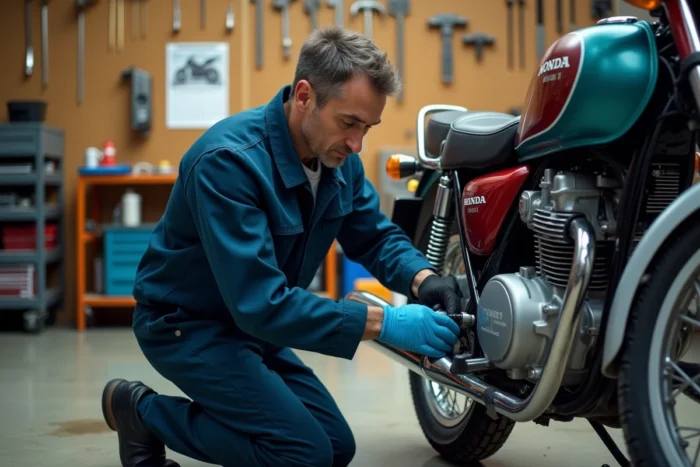
Real-world performance of the Dax 125 in loaded use
The official presentations emphasize the riding pleasure and playful character of the Dax. This narrative masks a reality that users discover after a few weeks: accelerations uphill and riding two-up put the engine to the test well beyond flat urban settings.
The Dax’s 2-valve single-cylinder engine is designed for low-end flexibility, not for pure performance. Solo on flat terrain, the accelerations remain brisk, and the engine responds readily. The 4-speed gearbox paired with the centrifugal clutch offers smooth, almost seamless shifts.
Two-up and inclines: where the engine shows its limits
When loaded with a passenger, the behavior changes. Accelerations from a stop on a slope become longer, and the engine revs higher to maintain speed on fast suburban stretches. The centrifugal clutch does not allow for slip control as a manual clutch would, which can be surprising on steep climbs.
For mixed city-suburban trips with a regular passenger, this point deserves consideration. The Monkey 125, with its 5-speed gearbox and manual clutch, offers a shorter first gear that facilitates starts on inclines, but it is not homologated as a two-seater.
Concrete maintenance plan for the Dax ST 125
The manufacturer’s manual exists, but the commercial pages and online technical sheets do not provide a usable summary. Here are the maintenance points to prioritize for this type of engine.
- Drive chain: check tension and lubrication every 500 to 1,000 km depending on use. The 12-inch wheels and compact size of the Dax amplify chain wear when riding two-up or on degraded surfaces.
- Engine oil level and condition: a single-cylinder engine with a single cam runs hotter in the city with frequent stops. A visual check of the level should become a reflex before every extended ride.
- Brake pads: the braking of a loaded 125 two-up wears the pads more quickly. A visual check of the thickness each season avoids unpleasant surprises.
- Tire pressure: 12-inch tires lose stability faster than larger diameter wheels when pressure drops. Checking every two weeks is recommended.
A often overlooked point concerns the battery. The backlit LCD instrumentation and full LED lighting consume little, but prolonged inactivity (several weeks without riding) can be enough to drop the voltage below the starting threshold.
Winter preparation for the Dax 125
Before a period of inactivity, three actions reduce the risk of degradation:
- Add a fuel stabilizer to the tank to prevent gasoline oxidation
- Connect a battery maintainer, especially if the vehicle remains outside
- Lubricate the chain and cables, then store the Dax on its center stand to avoid flat spots on the tires
Motorcycle technical inspection and Dax ST 125: what changes
The technical inspection for vehicles in category L (which includes registered 125 cm³) follows a progressive schedule in France. The Dax ST 125, as a registered vehicle in category L, will be subject to motorcycle technical inspection according to the regulatory schedule.
This inspection focuses on points directly related to routine maintenance: brake condition, lighting, noise level, tire condition. A Dax properly maintained according to the plan described above should not pose any particular difficulties during the inspection.
The characteristic stamped steel frame of the Dax has the advantage of being easy to visually inspect for potential corrosion points, a defect that could become a reason for a re-inspection on older models or those exposed to winter salt.
The overall maintenance cost of the Dax ST 125 remains moderate compared to more complex 125s (multi-valve injection, ABS with multiple sensors). The mechanical simplicity of the 2-valve single-cylinder works in favor of the owner, provided that the inspection intervals are respected and that the replacement of consumables is not delayed beyond reasonable limits.