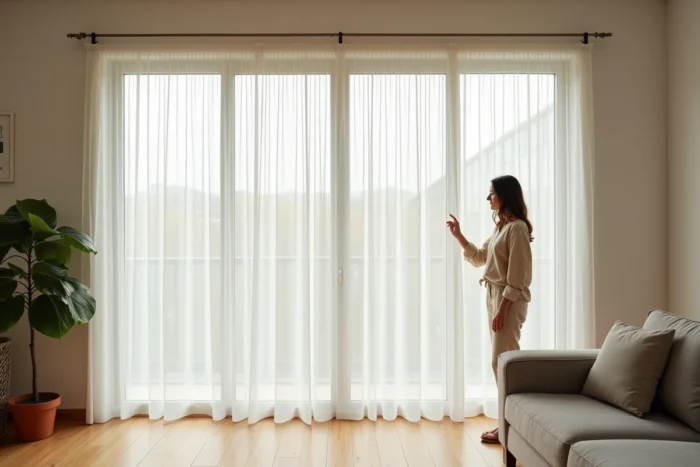
A mosquito net measuring 300×220 cm corresponds to the standard size for sliding glass doors with two panels. This template covers the entire opening without seams or cuts, ensuring a continuous physical barrier against flying insects. Understanding why this precise dimension makes a difference requires examining the mesh, fastening, and the current health context.
Large mosquito net: what the width of 300 cm changes during installation
Most mosquito nets sold in supermarkets cover openings from 120 to 160 cm wide. Moving to 300 cm does not simply mean doubling the fabric: it changes the supporting structure, the type of guidance, and the behavior of the fabric in the wind.
On a three-meter sliding glass door, a single fabric without lateral guiding rails will sag at the first breeze. The fabric deforms, creating gaps at the bottom or sides, allowing insects to pass through. Models designed for this size incorporate aluminum side tracks that keep the fabric taut over the full height of 220 cm.
Choosing a 300×220 mosquito net for sliding glass doors that is sized from the start also avoids the trap of artisanal resizing. Trimming a fabric that is too wide weakens the edges, prevents thermal welding of the perimeter, and accelerates fraying within a few seasons.
The height of 220 cm corresponds to the standard free passage under a lintel. It provides enough clearance to enter and exit without ducking, which is important on a daily basis when the sliding glass door serves as the main passage to a terrace or garden.
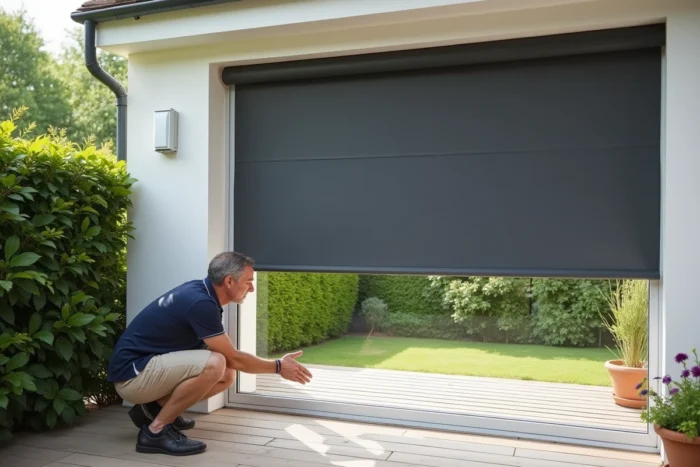
Fiberglass or polyester fabric: what mesh for a sliding glass door
The mesh determines both the filtration fineness and the airflow passing through. For an opening of three meters, the choice of material carries more weight than for a simple window, because the surface exposed to the wind is much larger.
- PVC-coated fiberglass remains the most common material. It offers good rigidity, resists UV rays, and can be cleaned with a water jet. Its standard mesh blocks mosquitoes, flies, and wasps without significantly reducing ventilation.
- Polyester, being more flexible, is suitable for pleated or retractable systems. Its lightness makes it easier to handle over large widths, but it stretches more over time and is less resistant to pet claws.
- Some technical fabrics called “anti-pollen” add a layer of microfiltration. On a 300 cm opening, this additional density can slow down airflow. It is then necessary to check that natural ventilation remains sufficient for the room.
The black color offers the best visual transparency from the inside. A gray or anthracite fabric creates a slight veil, while a white color reflects more light and reduces visibility to the outside.
Tiger mosquito and sliding glass door: a local health issue
Several French communities, such as Bordeaux Métropole or ARS PACA, now include the installation of mosquito nets on doors and windows in their official recommendations for combating the tiger mosquito. This recommendation is on par with body repellents and covering clothing.
The majority of tiger mosquito breeding sites are found on private properties. Terraces, gardens, and balconies are preferred laying areas. A three-meter sliding glass door opening onto these spaces thus represents a major entry point.
The mosquito net does not eliminate larvae, but it cuts off the circuit between the outside and the inside of the home. Combined with the removal of stagnant water (saucers, gutters, toys), it forms a coherent barrier without resorting to chemical insecticides.
Nocturnal ventilation and heatwaves
During periods of extreme heat, opening the sliding glass door at night can lower the indoor temperature by several degrees. Without a mosquito net, this passive cooling forces a choice between thermal comfort and bites. A mosquito net on a sliding glass door makes nocturnal ventilation viable without air conditioning.
This point becomes increasingly important as heatwave episodes recur. Limiting the use of air conditioning reduces electricity consumption and avoids releasing heat outside, which exacerbates the urban heat island effect.

Installation of a sliding or pleated mosquito net on a 300×220 opening
Two systems dominate the market for large sliding glass doors: the sliding mosquito net and the pleated mosquito net. Each meets different constraints.
The sliding mosquito net operates on the same principle as the panel of the sliding glass door. It slides on a lower rail and an upper rail, allowing the passage to be completely cleared. On 300 cm, a two-panel model offers smoother handling than a single panel, which is too heavy to move with one hand.
The pleated mosquito net folds like an accordion to one side. It takes up less space when open, but its mechanism is more fragile over large widths. The folds also accumulate dust, requiring more frequent maintenance.
- Check the depth of the frame: aluminum tracks require a few centimeters of clearance to avoid obstructing the closing of the sliding glass door.
- Prefer a low threshold (less than one centimeter) to avoid tripping during repeated passages.
- Check compatibility with an existing roller shutter or external blind, as the bulk of the box may reduce available space.
Fixing by screwing into the frame remains more stable than gluing or magnets, especially for an opening used several times a day. On an aluminum frame, self-tapping screws are sufficient. On PVC, it is necessary to drill at a slightly smaller diameter to avoid cracking the profile.
The 300×220 cm format is the direct dimensional response to standard sliding glass doors. Choosing a suitable mosquito net at the time of purchase avoids cutting compromises and sealing defects. With the spread of the tiger mosquito and the increase in hot nights, this mechanical protection becomes a logical complement to the sliding glass door, not a secondary accessory.