Choosing your sports equipment involves balancing several measurable parameters: fabric weight, sole cushioning, fabric breathability, and morphological fit. Each parameter affects performance differently depending on the discipline, level of practice, and usage conditions. This article compares the criteria that have the most impact on actual performance, supported by data.
Integrated sensors and connected textiles: what equipment really measures
Competitors rarely address the issue of equipment with integrated sensors. Sportswear with biometric sensors (IMU, heart rate, temperature) has, however, become widespread in recent years, including for amateur practitioners.
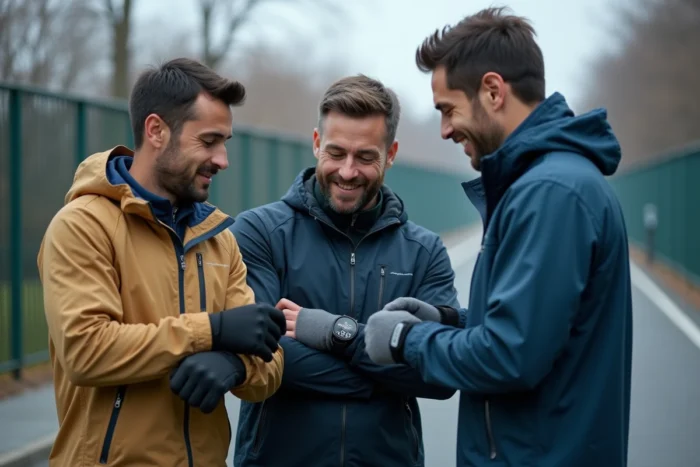
According to a review cited in 2026 by the Journal du Progressiste, portable IMUs display an angular accuracy of 2 to 8 degrees. This level of reliability is sufficient to correct a technical flaw in a squat, a running stride, or a throwing motion.
Connected shoes adjust the tightness based on data collected during exertion. Sensor-equipped shirts measure muscle activation in real-time. For a runner, this means immediate feedback on stride symmetry, an indicator directly linked to injury risk.
Before investing in a connected accessory, check that the sensor measures a parameter you can actually utilize. A heart rate sensor integrated into the shirt makes sense if you are working in cardio zones. A muscle activation sensor provides no benefit without a structured training plan to interpret the data.
To explore the ranges available by discipline, sports equipment on Bonjour Sportif allows you to compare references suited to each practice.
Running and football shoes: comparison of selection criteria
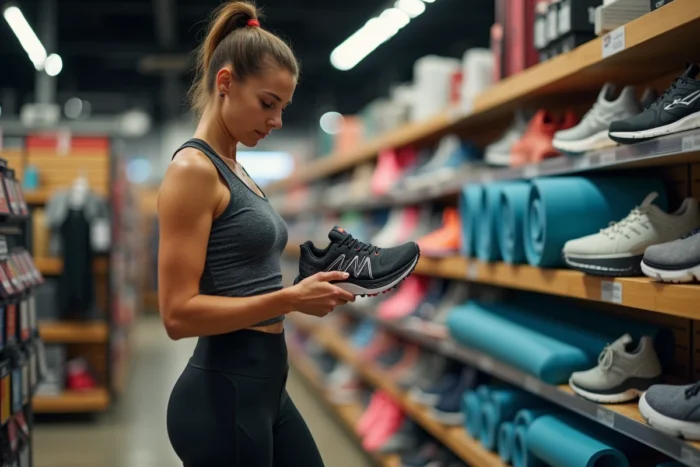
The choice of shoes involves different criteria depending on whether you are running on the road or playing on grass. The table below contrasts the decisive parameters for these two disciplines.
| Criterion | Running Shoes | Football Shoes |
|---|---|---|
| Cushioning | Primary (shock absorption on asphalt or trail) | Secondary (grass naturally cushions) |
| Weight | Direct performance factor for long distances | Less determining than grip |
| Grip / Studs | Smooth or slightly cleated sole depending on terrain | Molded or screw-in studs depending on surface |
| Lateral Support | Moderate (dominant linear movement) | Enhanced (frequent direction changes) |
| Breathability | High (prolonged effort, abundant sweating) | Medium to high depending on position |
In running, the weight of the shoe and the quality of cushioning directly determine comfort over time. In football, lateral support and the type of studs take precedence over weight. A player using molded studs on wet ground loses grip and increases their risk of slipping.
In both cases, shoe size deserves special attention. The foot swells during exertion. A half size above the usual size prevents compression and blisters, especially in running.
Sports clothing: breathability and compression face to face
The choice of sportswear is based on two distinct logics: breathability (heat and moisture evacuation) and compression (muscle support and vibration reduction).
- Breathable textiles made from synthetic fibers wick sweat away from the fabric. A breathable shirt reduces overheating during prolonged efforts such as running or cycling.
- Compression garments apply calibrated pressure to muscle groups. They are primarily used to limit muscle oscillations during exertion and promote recovery afterward.
- A garment can combine both properties, but the fabric weight increases with the level of compression, which mechanically reduces breathability.
For outdoor endurance sports (running, road cycling), breathability is the priority. For impact sports or short, intense efforts (football, weight training), compression provides a more noticeable benefit.
Environmental regulations and sustainability of sports equipment
New European environmental regulations are beginning to change the composition of sports equipment. Manufacturers must gradually reduce the use of certain chemicals in textiles and cushioning foams.
This has a concrete impact on consumer choice. Some ultra-light foams used in running soles have seen their formulation evolve. The durability of the material is becoming a selection criterion on par with weight.
Equipment that loses its cushioning properties after a few hundred kilometers is more expensive to use than a slightly heavier but more durable model. Checking the lifespan advertised by the manufacturer and cross-referencing it with user feedback remains the most reliable method for making a decision.
Accessories and comfort: the details that change performance
Accessories are often overlooked in the selection process. However, a few elements deserve specific attention:
- Technical socks with reinforced zones limit friction and chafing, especially in running.
- Sports glasses with anti-fog treatment and UV protection are useful beyond cycling: trail, cross-country skiing, water sports.
- Removable insoles allow for cushioning adjustment or correction of a support defect without changing shoes.
A well-chosen accessory corrects a flaw that the shoe or garment cannot compensate for alone. Investing in a good pair of insoles is cheaper than replacing unsuitable shoes.
The choice of sports equipment benefits from being treated as a technical decision rather than an impulsive purchase. Cross-referencing the type of practice, personal physical constraints, and measurable data (weight, cushioning, breathability, sensor accuracy) reduces the risk of error. The best equipment is the one that corresponds to a specific use, not the one that boasts the most technologies on the label.