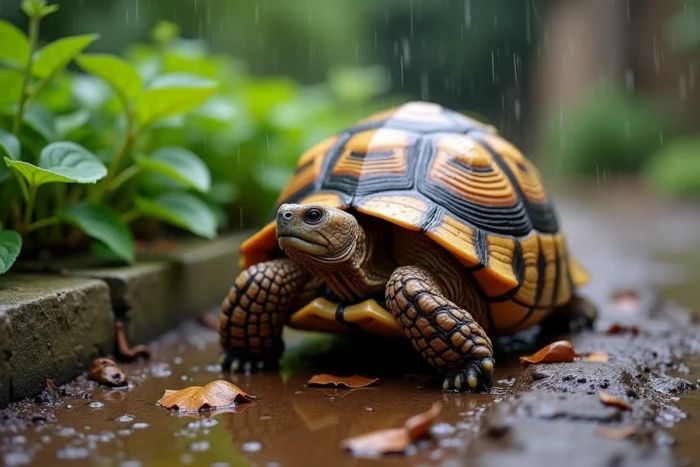
Land turtles, like the Hermann’s tortoise, live outdoors all year round in most regions of France. Rain is part of their natural environment. Their shell protects them from moderate weather conditions, and a typical shower does not pose a danger in itself for a healthy animal, settled in a properly arranged enclosure.
Runoff Water Pollution: An Overlooked Risk for the Enclosure
Most discussions about rain and land turtles revolve around temperature or humidity. However, a rarely mentioned factor deserves attention: the quality of the water that runs off into the enclosure.
In urban or suburban areas, rainwater becomes contaminated as it comes into contact with the surfaces it traverses. Hydrocarbons from a nearby road, residues of treatment products washed off from a roof or terrace, microplastics carried by runoff: these substances end up in the soil of the enclosure, where the turtle eats, drinks, and burrows.
An enclosure located below a paved driveway or treated terrace receives these pollutants with every rain event. The turtle then ingests contaminated particles while grazing on wet grass or drinking from puddles.
To limit this risk, it is often sufficient to check where the water entering the enclosure comes from. A slope, a raised border, or a simple diversion of the runoff flow prevents contaminated water from reaching the living area. This is a design point to consider, including to know if turtles like rain or if they passively endure it depending on the conditions of their enclosure.
Prolonged Humidity and Land Turtles: When the Soil Becomes the Real Problem
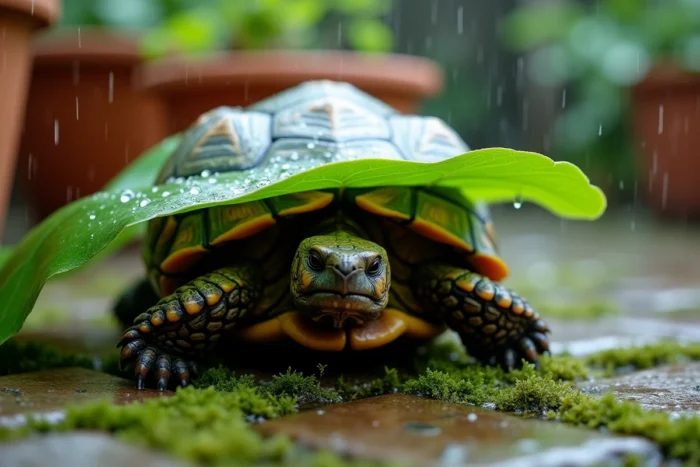
A brief shower does not pose a difficulty. It is the stagnant humidity in the soil that weakens land turtles. The distinction between these two situations is fundamental to understand when to intervene.
The substrate plays a central role. Clayey or compacted soil retains water on the surface and creates persistent muddy areas. The turtle, which spends a large part of its time on the ground, finds itself in prolonged contact with waterlogged substrate. This contact promotes skin infections, particularly on the plastron (the ventral part of the shell).
Signs of an Inadequate Substrate
- Puddles that persist for more than a few hours after rain, indicating insufficient drainage
- A plastron that remains damp or shows whitish spots, indicating the onset of a fungal infection
- A turtle that remains motionless in a soaked corner instead of seeking a dry shelter, which may signal weakness
A mix of garden soil and dead leaves offers a good compromise. Dead leaves absorb excess water while allowing the turtle to burrow. Straw also works, but it molds faster in humid conditions and needs to be replaced regularly.
Shelter from Rain in the Enclosure: Design and Common Mistakes
Any land turtle kept outdoors in a garden needs a shelter that is accessible at all times. Rain is not the only reason (excessive heat is another), but it is the one that determines the design of this shelter.
The shelter should be placed directly on the ground, with an opening facing away from the prevailing winds. A simple turned tile, often recommended on forums, protects from light rain but not from a heavy downpour accompanied by wind. A shelter closed on three sides with a waterproof roof offers significantly more reliable protection.
What Makes a Shelter Effective
- A raised floor a few centimeters above the surrounding ground level, to prevent water from entering through the base
- A dry substrate inside (hay, dry leaves) renewed after each significant rain event
- Dimensions sufficient for the turtle to enter and turn around, but not too large, as a small volume retains heat better
- A complete absence of cross drafts, which would cool the animal instead of protecting it
A common mistake is to bring the turtle inside the house or apartment when it rains. These sudden changes in temperature and humidity disrupt the animal’s metabolism. A Hermann’s tortoise accustomed to living in an outdoor enclosure in a garden copes much better with a shower in its shelter than with a back-and-forth between the cold, damp outside and the dry, warm interior.
Heavy Rains and the Risk of Flooding the Enclosure
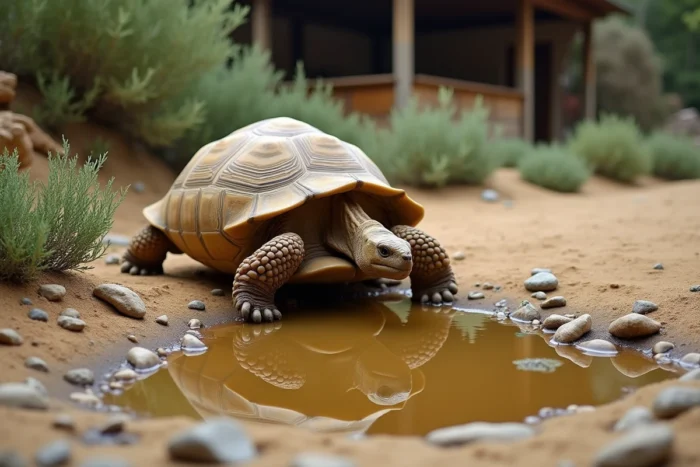
Episodes of intense rain, increasingly frequent, pose a specific problem. An enclosure located in a natural dip in the garden can turn into a temporary pond. For a land turtle, even a few centimeters of stagnant water represent a real danger if it cannot escape.
Land turtles do not swim. They can drown in very shallow water if they find themselves on their back or trapped against a wall. A well-thought-out enclosure therefore includes a raised area, a slight slope that allows water to drain naturally, and the absence of depressions where water could accumulate.
The question also arises for juvenile turtles, which are smaller and more vulnerable. Their reduced size exposes them more to drowning in water accumulations that adults would easily cross. A fine mesh that prevents escapes can also block water flow if leaves or debris accumulate on it.
In summary, rain does not directly threaten a healthy land turtle. It is the consequences of rain on its environment that matter: soil that does not drain, poorly designed shelter, a dip enclosure, or polluted runoff. Arranging the enclosure with these parameters in mind is enough to make rainy days perfectly harmless for the animal.