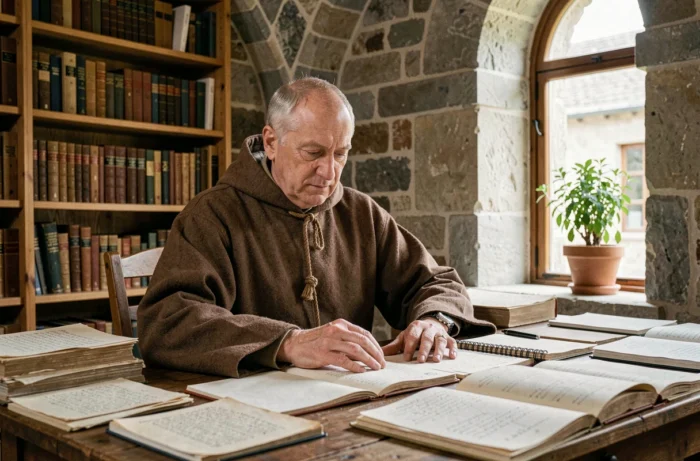
Catholic monks in France do not receive a salary. This statement, often summarized in one sentence, masks a much richer and more structured economic functioning than it appears. Behind the vow of poverty lies a collective system where income exists but is never individual.
Vow of poverty and common fund: how monastic economy works
When a monk takes his vows, he renounces personal property. In practical terms, this means he has neither a personal bank account nor personal assets. All income is paid into a common fund managed by the community.
This common fund covers everyday needs: food, clothing, medical care, building maintenance. The monk does not receive a monthly allowance. His personal expenses, when they exist, go through a request to the community’s treasurer.
To better understand the annual income of Catholic monks, one must think at the level of the monastery, not the individual. A monk’s income is what his community generates collectively, divided not into equal shares, but redistributed according to each person’s actual needs.
Sources of income for monasteries in France: work, sales, and hospitality
French monasteries do not live solely on prayer. Their resources come from several channels, often combined.
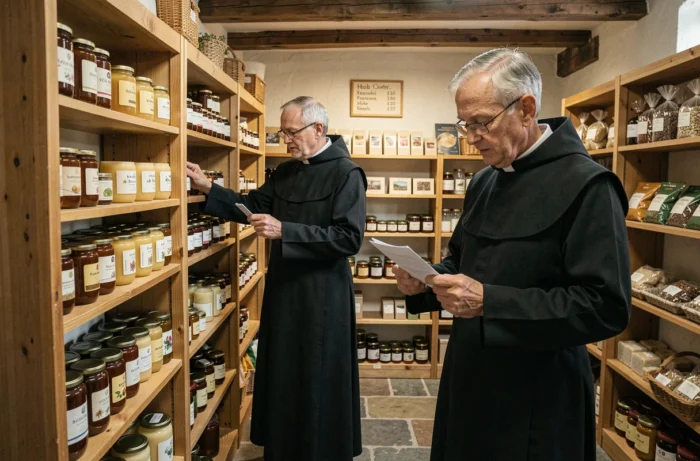
- Artisanal and food production: beers, cheeses, jams, cookies, cosmetics. These products are sold in abbey shops or increasingly through online sales sites. The monastic brand is explicitly used as a commercial argument.
- Monastic hospitality: many abbeys offer stays, ranging from spiritual retreats to tourist accommodations. Prices vary by location, but this activity represents a significant part of the budget.
- Donations, legacies, and offerings: faithful individuals or benefactors regularly contribute to the functioning of the communities. Some monasteries also receive bequests.
Online commerce has become an increasing relay for communities facing heavy heritage maintenance costs. A report by TF1 broadcast in August 2026 highlighted this shift towards remote sales, with monks developing their digital presence to reach a wider audience.
Financial burdens and constraints of French abbeys
Talking about income without mentioning expenses gives an incomplete picture. Monasteries face considerable expenses, often underestimated.
The maintenance of built heritage absorbs a major part of the resources. Many abbeys occupy classified or listed historical buildings. Compliance work (fire safety, accessibility, energy renovation) represents sums that the sales of monastic products alone do not always cover.
Some communities are exploring innovative models to finance these restorations. The partial conversion of buildings into tourist accommodations or cultural spaces is part of the adopted strategies. Heritage then becomes an economic lever in itself, not just a line of expense.
Social security and coverage for monks
Religious individuals in France benefit from affiliation with social security. The community contributes for each of its members, giving them access to healthcare and a modest pension. This point is often overlooked: the vow of poverty does not exclude social protection.
Monastic income and taxation in France: what the law says
Religious communities in France generally operate under an associative status (cult association or recognized congregation). This legal framework determines their relationship to taxation.
Recognized congregations benefit from specific tax exemptions, particularly on donations and legacies received. Commercial activities (sale of products, hospitality) may, however, be subject to tax if they exceed certain thresholds or are deemed competitive by the tax administration.
A monk does not individually declare personal income since he does not receive any. It is the legal entity (the congregation, the association) that bears the tax obligations. This distinction is fundamental to understanding why one cannot simply answer the question “how much does a monk earn per year.”
Why the question of a monk’s “salary” doesn’t really make sense
Searching for an annual amount in euros for a Catholic monk is applying a salary scale to a way of life that rejects it by principle. The vow of poverty is not a symbolic posture: it legally and materially structures the life of the religious.
What comes closest to an “income” for a monk is the value of the goods and services that the community provides him: housing, food, clothing, care. This total provision replaces the notion of salary.
The data sometimes cited on salary estimation sites (a few hundred or thousand euros per month) actually correspond to averages calculated on salaried positions in religious structures, such as chaplains or teachers. These figures do not reflect the reality of a monk living in community under a vow of poverty.
The monastic economic model remains a unique case in the French landscape. It relies on mutualization, collective work, and a form of sobriety that makes comparison with a traditional job inappropriate. For communities that manage to balance their accounts, the sale of products, hospitality, and donations form a sufficient tripod. For others, the question of viability arises acutely, especially when numbers decline and heritage costs increase.